

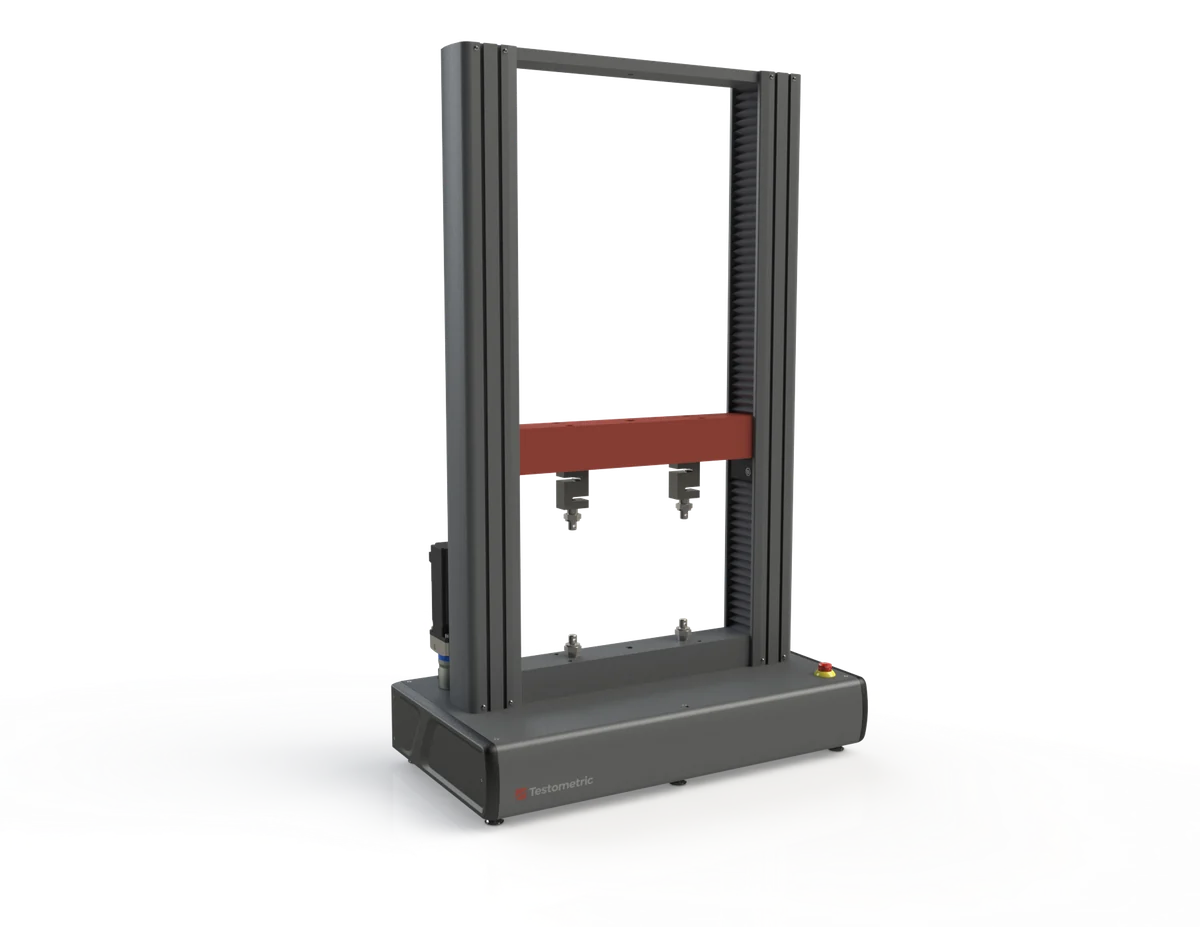
Dual Station Universal Testing Machine (Testometric X500-620W)
Wide 620 mm twin-column UTM (25 to 100 kN) mounting two dedicated Class 0.5 load cells and staged fixtures side by side - switch between low/high force ranges or tensile and compression/flexure with zero grip changeover.
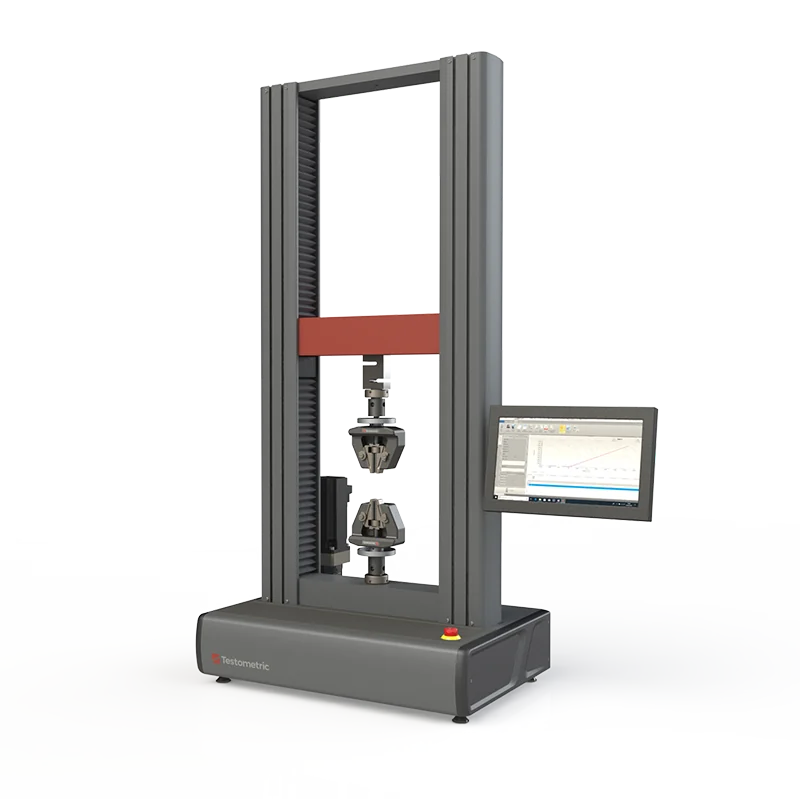
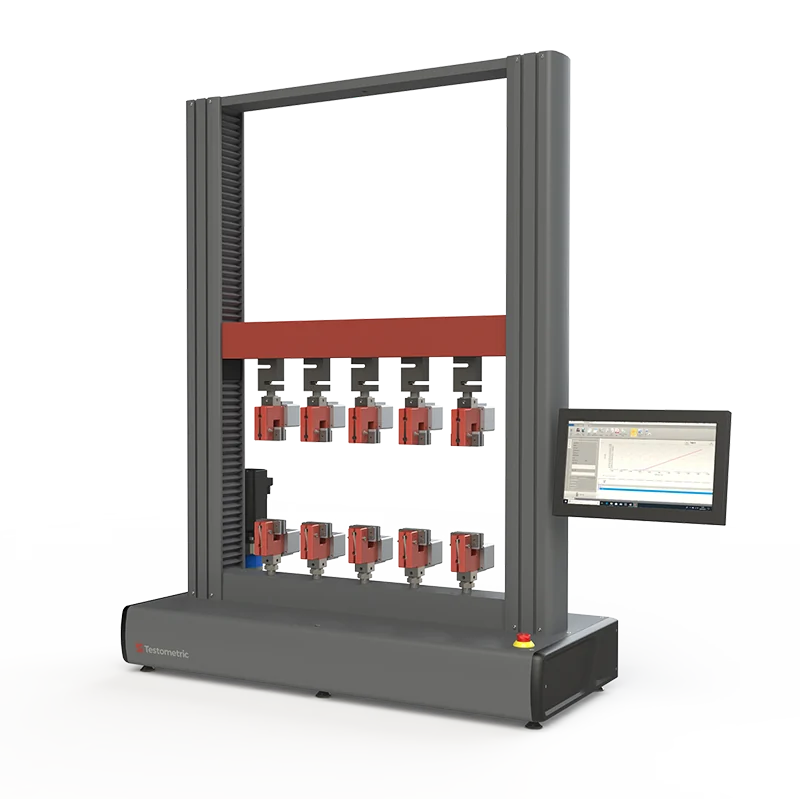
FITCO India Commissioning & Global Reference Users
Trusted across Testometric laboratories worldwide; commissioned across India by FITCO
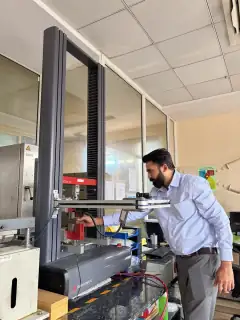
Specified, commissioned and verified in India by FITCO for controlled-temperature tensile and peel testing (customer identity withheld).
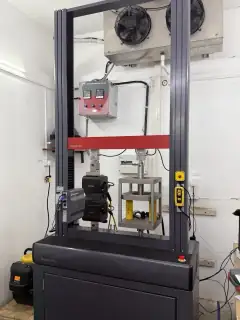
Commissioned in India by FITCO for ASTM D4595 / D4632 wide-width geotextile strip and grab tensile testing (customer identity withheld).











Worldwide users of Testometric systems. Worldwide inclusion does not mean FITCO supplied that installation. FITCO (Federal India Trading Company, est. 1950) specifies, commissions, calibrates and supports Testometric universal testing machines across India. FITCO supplies equipment and is not a contract testing laboratory.
What Is a Dual Station Universal Testing Machine?
A dual station universal testing machine (dual station UTM) uses a wide-column twin-screw load frame - such as the UK-built Testometric X500-620W (25 to 100 kN, 620 mm between columns) - to mount two independent load cells and two permanently aligned fixture sets side by side beneath a single moving crosshead. Laboratories switch instantaneously between two force ranges (for example, a low-force LC10 or LC100 cell for peel, film or adhesive tests alongside a 25 to 100 kN cell for tensile, compression or flexure) without unbolting grips, re-centring jaws or risking calibration drift.
- Zero grip or load-cell changeover: Keep two complete fixture setups permanently mounted, aligned and ready across shifts.
- Two independent ISO 7500-1 Class 0.5 ranges: Pair a low-capacity cell (±0.5% accuracy down to 1/1000 of rated load) beside a full-capacity X500 cell on the same frame.
- Half the benchtop footprint of two UTMs: Save laboratory bench space, PC licences and single-phase electrical drops compared with buying two standalone machines.
- Automatic winTest station selection: Testometric auto-recognised load cells and stored ASTM/ISO methods prevent wrong-cell selection and operator setup errors.
Four High-ROI Dual Station UTM Configurations
Each Testometric X500-620W dual station layout is configured by FITCO engineers around your exact two-method force windows, specimen widths and fixture clearances.
01 · Low-Force + High-Force Dual Load Cells
Mount a low-range load cell (such as 50 N to 2.5 kN) on Station 1 for thin film tensile, 90°/180° peel, seal strength or separator puncture, while Station 2 carries a 25 to 100 kN cell for rigid plastics, composites, metals or geotextiles.
02 · Permanent Tensile + Compression / Flexure
Leave pneumatic or hydraulic wedge tensile grips permanently aligned on Station 1 and rigid compression platens or a 3-point bend rig permanently set on Station 2 - switch from ASTM D638 / ISO 527 tensile to ASTM D790 / D695 in seconds.
03 · Packaging, Adhesive & Seal QA Pair
Stage peel, adhesion or ASTM F88 pouch-seal jaws on one side and puncture, tear, lap-shear or crush platens on the other so QA technicians release mixed incoming and outgoing lots without re-rigging between shifts.
04 · High-Throughput Dual Production QC
Configure two identical fixture sets or paired raw-material and finished-component rigs on one rigid 620 mm frame with locked winTest recipes, pass/fail tolerances and direct PDF/CSV/Excel/LIMS export.
Dual Station UTM vs Standard UTM vs Two Separate UTMs vs X500MS
Choose the right Testometric architecture based on changeover frequency, force-window spread, bench footprint and whether tests run sequentially or across many repetitive QA lanes.
| Evaluation factor | Dual Station UTM (X500-620W) | Standard Single-Station (X500) | Two Separate UTMs | Multi-Station (X500MS) |
|---|---|---|---|---|
| Horizontal column space | 620 mm wide twin-column | 420 mm standard twin-column | Two separate bench footprints | Custom multi-lane spacing |
| Active test stations | 2 side-by-side independent stations | 1 central test axis | 2 fully independent frames | Multiple staged production lanes |
| Fixture & cell changeover | Zero changeover between 2 staged methods | Manual unbolting, re-centring & cell swap | Zero changeover (2 machines) | Zero changeover for dedicated repetitive runs |
| Dual force-window accuracy | Two dedicated Class 0.5 cells mounted simultaneously | Requires manual cell swap for low vs high load | Independent cells on separate frames | Matched cells per QA station |
| Concurrent operator use | One shared servo crosshead (sequential station use) | Single specimen at a time | Two operators simultaneously | Synchronised or staged multi-specimen QA |
| Power, PC & bench space | 1 single-phase frame, 1 PC, 1 winTest licence | 1 single-phase frame, 1 PC | 2 frames, 2 benches, 2 PCs & calibration schedules | 1 benchtop frame, custom guarding |
| Best-fit laboratory | Multi-method QA & R&D labs running 2 distinct fixtures or force bands daily | Single primary method or infrequent fixture changes | Continuous 24/7 parallel operation by two operators | High-volume shift QA repeating the same component check |
Testometric X500-620W Dual Station Technical Specifications
Built on the UK-manufactured Testometric X500 heavy-duty twin-column electromechanical platform with 620 mm expanded column spacing. Final station pitch, maximum grip width and load-cell pairing are confirmed by engineering drawing before order.
| Parameter | X500-25 (620W) | X500-30 (620W) | X500-50 (620W) | X500-100 (620W) |
|---|---|---|---|---|
| Frame force capacity | 25 kN | 30 kN | 50 kN | 100 kN |
| Width between columns | 620 mm wide-frame configuration (expanded from standard 420 mm X500 spacing to accommodate dual test stations) | |||
| Dual station architecture | Two side-by-side load-cell mounting positions beneath the moving crosshead with aligned base anchor mounts; load cells sized independently to each working force window | |||
| Force measurement accuracy | Better than ±0.5% of reading down to 1/1000 of rated load-cell capacity (ISO 7500-1 Class 0.5, ASTM E4, EN 7500-1, DIN 51221) | |||
| Interchangeable load cells | Full Testometric 5 N to 100 kN auto-recognised load-cell range with electronic calibration storage and overload protection | |||
| Crosshead travel (standard) | 1025 mm | 1025 mm | 950 mm | 1075 mm |
| Vertical test space (daylight) | 1225 mm | 1225 mm | 1150 mm | 1300 mm |
| Position control resolution | 0.000001 mm | |||
| Crosshead speed range | 0.00001 to 1000 mm/min | 0.00001 to 1000 mm/min | 0.00001 to 1000 mm/min | 0.00001 to 500 mm/min |
| Speed accuracy | ±0.1% under stable operating conditions | |||
| Frame axial stiffness (base X500) | 120 kN/mm | 120 kN/mm | 220 kN/mm | 400 kN/mm |
| PC data acquisition rate | 500 Hz standard; 1000 Hz optional for brittle fracture, rapid peel and tear peaks | |||
| Control software | winTest Analysis: 300+ ASTM/ISO/EN/DIN templates, locked station methods, live curves, SPC statistics, PDF/CSV/Excel/LIMS export, optional 21 CFR Part 11 audit trails | |||
| PC interface | Ethernet (USB via adaptor) | |||
| Electrical supply & power | 115/230 V, 1 ph, 50/60 Hz · 1 kW | 115/230 V, 1 ph, 50/60 Hz · 1 kW | 115/230 V, 1 ph, 50/60 Hz · 1 kW | 115/230 V, 1 ph, 50/60 Hz · 1.2 kW |
| Operating environment | 0 to +55 °C; relative humidity 90% RH or less (non-condensing) | |||
Note: Base mechanical ratings follow the Testometric X500 datasheet. Exact dual-station centre spacing, overall frame width, machine mass, off-centre load-limit guidance and interlocked safety guarding for the 620W wide build are confirmed in FITCO's formal technical proposal.
Standards Supported Across Dual-Station Testometric Laboratories
Run contrasting international methods side by side on one X500-620W frame with dedicated fixtures and pre-programmed winTest calculation templates.
| Test discipline | Typical ASTM / ISO standards | Typical station pairing on X500-620W |
|---|---|---|
| Plastics tensile & flexure | ASTM D638, ISO 527-2, ASTM D790, ISO 178, ASTM D695 | Station 1: Tensile wedge/pneumatic grips + extensometer · Station 2: 3-point bend or compression platens |
| Films, packaging & seals | ASTM D882, ISO 527-3, ASTM F88, ASTM D1004 | Station 1: Low-force cell (LC10-LC250) with pneumatic film/seal grips · Station 2: Puncture, tear or crush fixture |
| Adhesives, tapes & coatings | ASTM D903, ASTM D3330, ASTM D429 | Station 1: Low-load 90°/180° peel fixture · Station 2: High-force lap shear or substrate bond grips |
| Rubber & elastomers | ASTM D412, ISO 37, ASTM D624, ASTM D575 | Station 1: Self-tightening pneumatic tensile/tear grips · Station 2: Compression platens for deflection checks |
| Metals, composites & geosynthetics | ASTM E8/E8M, ISO 6892-1, ASTM D3039, ASTM D4595 | Station 1: High-force hydraulic or wedge grips (up to 100 kN) · Station 2: Secondary compression, bend or seam/peel rig |
| Force verification & calibration | ISO 7500-1 Class 0.5, ASTM E4 | Independent traceable verification coordinated for both installed load cells where required by your quality system |
Four Testing Failure Modes Eliminated by a Dual Station UTM
Frequent grip and load-cell swaps are one of the highest hidden causes of scatter, jaw breaks and out-of-tolerance audits in multi-method Indian QA laboratories.
Testing a 30 N peel or thin film strip on a 50 kN cell operates below ISO 7500-1 Class 0.5 floor (1/1000 of capacity = 50 N). A dedicated low-capacity second station eliminates that error permanently.
Repeatedly removing and re-pinning wedge grips introduces concentricity drift that triggers premature jaw breaks. Permanently staged fixtures hold verified alignment shift after shift.
Swapping load cells several times a week risks thread wear, cable strain and missed zero checks. Leaving both auto-recognised cells mounted protects calibration stability.
Heavy hydraulic or wide grips take 15 to 30 minutes to change and verify. With two stations locked to dedicated winTest methods, operators switch test modes in under a minute.
Inputs Required for an X500-620W Dual Station Quotation
FITCO specifies, installs, trains and coordinates ISO 7500-1 / ASTM E4 force verification across India. Share these details so our application engineers verify clearances, station pitch and load-cell sizing before quoting:
- Station 1 test brief: Material, specimen dimensions, ASTM/ISO method, expected peak and working force range, grip/fixture type and extensometry.
- Station 2 test brief: Second material or test mode (compression, bend, peel, puncture or second tensile range), peak load and fixture width/height.
- Crosshead speed & travel: Starting grip separation, maximum elongation or compression stroke, and target test speed under load.
- Software, guarding & site scope: winTest reporting fields, LIMS export, optional 21 CFR Part 11 audit trail, interlocked front guard, base cabinet and calibration scope.
Frequently Asked Questions About Dual Station UTMs
Direct engineering answers covering Testometric X500-620W load cells, station independence, ASTM/ISO compliance, winTest workflows and quotation scope in India.
What is a dual station universal testing machine (dual station UTM)?
How is the Testometric X500-620W Dual Station UTM different from the X500MS Multi-Station Tester?
Can Station 1 and Station 2 use two different load-cell capacities on the same frame?
Can a dual station UTM run tensile testing on one station and compression or flexure on the other?
Does a dual station UTM test two specimens simultaneously or one active station at a time?
How does winTest Analysis software manage two load cells and test stations?
Which ASTM and ISO standards can a Testometric X500-620W dual station UTM perform?
What determines the price and quotation scope of a dual station UTM in India?
Configure Your Testometric X500-620W Dual Station UTM
Share Station 1 and Station 2 specimen details, force windows, fixtures and ASTM/ISO methods. FITCO will verify dual-station clearances and issue a complete technical and budgetary proposal for India delivery, commissioning and calibration coordination.