
ASTM D412 – Tensile Properties of Vulcanized Rubber and Thermoplastic Elastomers
The world's most widely cited rubber tensile standard: a complete lab guide to dumbbell selection, grip best practice, extensometry, crosshead speed, formula derivation, and compliant reporting — calibrated for Testometric universal testing machines supplied by FITCO India.
Overview & scope
ASTM D412 is the primary American standard for determining the tensile stress-strain properties of vulcanized thermoset rubber and thermoplastic elastomers (TPE). It is maintained by ASTM Committee D11 on Rubber and Rubber-like Materials and is the default compliance reference for tyre compounders, seal manufacturers, rubber goods producers, and NABL/ISO 17025-accredited test laboratories worldwide.
The standard defines two test methods:
- Method A – Dumbbell and Straight Section specimens: the most common method, using die-cut dumbbell specimens. Produces tensile strength, elongation at break, and modulus at defined elongations.
- Method B – Ring specimens: used for extruded profiles or hoses where a rectangular ring is cut. Results are expressed differently and are not directly comparable to Method A.
Tip: Die C (the most popular dumbbell) has a 25.4 mm gauge length and a 6.35 mm wide waist. When comparing data across labs, always state the die type — switching from Die C to Die B will change reported elongation values, even from the same compound.
Who mandates ASTM D412?
OEM automotive specifications (Ford, GM, Stellantis), MIL-SPEC and aerospace compound approvals, ASTM International raw material product standards, and ISO 9001/IATF 16949 QC plans for rubber components.
What does it measure?
Tensile strength at break (MPa), elongation at break (%), modulus at 100 / 200 / 300% elongation (MPa), and yield point (for TPEs). Does not measure hardness or tear — see ASTM D2240 and ASTM D624 respectively.
Sample materials
Natural rubber (NR), SBR, NBR, EPDM, silicone (VMQ), neoprene (CR), polyurethane (PU), TPV, TPE-E, thermoplastic polyurethane (TPU), latex, and rubber-bonded substrates.
Latest edition
ASTM D412-23. Check astm.org for the current revision. Editions before 2006 differ in some extensometer requirements — confirm the revision required by your customer specification.
Specimen types & geometry
ASTM D412 defines six dumbbell dies (A through F) plus straight specimens and ring specimens. Each produces different gauge lengths and waist widths, which affect reported elongation values. Die C is the international default and should always be used unless a customer specification mandates another.
| Die Type | Overall Length (mm) | Waist Width (mm) | Gauge Length (mm) | Typical use |
|---|---|---|---|---|
| Die A | 115 | 6.0 | 33.0 | ASTM/general purpose, older specifications |
| Die C | 115 | 6.35 | 25.4 | Default – most widely used globally |
| Die B | 75 | 3.18 | 20.0 | Micro specimens, thin sheet, limited material |
| Die D | 50 | 6.35 | 12.7 | Small compound samples, laboratory screening |
| Die E | 115 | 3.18 | 25.4 | High-precision elongation research |
| Die F | 150 | 25.0 | 25.4 | Wide-waist dumbbell for reinforced compounds |
| Straight (25×6 mm) | — | 6.0 | 20.0 | When die-cutting is not possible; less preferred |
| Ring specimens | O.D. varies | N/A | Circumferential | Extruded rope/hose profiles (Method B) |
Specimen thickness: typically 1.6–3.2 mm (0.063–0.125 in) cut from a standard compression-moulded slab. Thickness must be measured at three or more points in the gauge section; report the median.
Minimum number of specimens: test at least five (n ≥ 5) specimens per sample lot when results will be used for quality decisions or comparison. Increase to n = 10 for R&D compound ranking or when batch variability is suspected.
Note: Specimens must be tested within 96 hours of moulding for natural rubber compounds, or per any specific aging protocol in the governing specification. Always document storage conditions between moulding and testing.
Specimen preparation
- Die-cut at ambient temperature (23°C ± 2°C). Cold rubber cuts cleanly; warm specimens tend to have ragged edges that create stress concentrations. If the rubber is very stiff, allow it to equilibrate at room temperature for at least 30 minutes before cutting.
- Use a sharp, undamaged die. A blunt or nicked cutting edge produces uneven specimens with premature failures in the waist. Inspect die edges under 10× magnification regularly and resurface or replace when edge radius exceeds 0.05 mm.
- Mark gauge points before testing. For Method A, apply two indelible ink marks or thin strips of adhesive foil on the waist section 25.4 mm apart (for Die C). These are the reference points for extensometer clip placement or video gauge tracking.
- Condition specimens. ISO 23529 (general rubber conditioning) requires 23°C ± 2°C, 50% ± 5% RH for a minimum of 3 hours, preferably 24 hours. ASTM D412 references ASTM D1349 for conditioning — confirm which your specification requires. Record actual temperature and humidity.
- Measure and record dimensions. Measure the width and thickness of the waist section with a calibrated micrometer (resolution ≤ 0.01 mm). Calculate the cross-sectional area A₀ = width × thickness. Any specimen with visible surface defects, bubbles, or inclusion contamination should be discarded and not included in the reported dataset.
Grip selection — the most common source of test failure
Grip failure (specimen breaks inside or at the jaw face rather than in the gauge section) is the single most common reason rubber tensile tests are invalid. ASTM D412 requires that failures within the grip area be discarded. The right grip design largely eliminates this problem.
Self-tightening roller grips (STR1)
The Testometric STR1 self-tightening roller grip is the recommended solution for ASTM D412 dumbbell specimens. As tension increases, the rollers pivot inward and clamp progressively harder — no hydraulic supply needed. Available in 25 mm and 50 mm jaw widths to accommodate Die C and wider specimens. Zero specimen preparation beyond standard die-cutting.
Pneumatic rubber grips
Ideal for high-throughput QC labs. Pneumatic grips open and close at a set pressure (typically 4–6 bar). Use rubber-faced or serrated jaw inserts matched to the specimen thickness. Consistent clamping force reduces operator-to-operator variability. Always verify by pre-marking the tab and confirming no jaw slip on a test run before collecting data.
Wedge grips (not recommended for most rubber)
Standard wedge grips are unsuitable for soft, high-elongation rubbers — they concentrate stress at the jaw edge and cause premature grip-area failures. If cost or availability force their use, apply 80-grit sandpaper jaw faces and ensure symmetrical seating of the dumbbell tab. Still expect higher reject rates.
Ring specimen fixtures
For Method B ring specimens, use two smooth, polished cylindrical mandrels of the diameter specified in D412. Both mandrels must expand at equal speed (symmetric loading). Testometric ring specimen fixtures maintain alignment and are available for rings from 20 to 60 mm inner diameter.
Tip: Always zero the balance load after gripping and before starting the test. Gripping a rubber dumbbell typically introduces a small pre-load (~0.5–2 N) — failing to tare this will inflate your first data points and warp the stress-strain curve at low strains.
Instrumentation & extensometry
Accurate elongation measurement is critical for rubber because specimens routinely stretch 400–1000% before breaking. Crosshead displacement is not acceptable as a substitute for direct gauge-length measurement — ASTM D412 is explicit that results reported without an extensometer must be flagged as estimated values.
Non-contact video extensometer (recommended)
High-resolution cameras track ink marks or foil dots placed at the gauge points. No attachment to the specimen means zero perturbation of the stress field. Capable of measuring to >1000% elongation with ±0.5% accuracy. The Testometric VE video extensometer system is factory-calibrated to ASTM D412 gauge length requirements and integrates directly with WinTest Analysis software.
Long-travel contact extensometer (DE-A3)
Clip-on extensometer with 850 mm travel range and 0.01 mm resolution. The knife-edge clips are designed specifically for rubber — curved, low-friction contact prevents embedding and slipping. Suitable for elongations to ~800%. Verify before each test that clips seat securely on the gauge marks without cutting into the specimen surface.
Load cell selection
Select a load cell so that the expected peak force falls between 20% and 80% of the cell's rated capacity. For typical 2 mm thick Die C rubber specimens: soft compound (~5 MPa TS) → peak ~100 N → use 200 N or 500 N cell; hard compound (~25 MPa TS) → peak ~500 N → use 1 kN cell. An undersized cell risks overload damage; an oversized cell degrades force resolution at low strain.
Data acquisition
Sample at a minimum 50 Hz for standard tests. For TPE hysteresis characterisation or fatigue programmes, use 500–1000 Hz. ASTM D412 does not mandate a specific data rate, but lower rates can miss the peak force at fast crosshead speeds, resulting in under-reported tensile strength.
Test procedure — step by step
- Record environmental conditions. Log temperature (23°C ± 2°C target), relative humidity, and test date/time for every batch. If the lab is outside standard conditions, note the deviation — it may be required for interpretation of outliers later.
- Verify machine calibration status. Confirm load cell and extensometer calibration certificates are current (typically annual). Zero both load and displacement/extensometer channels.
- Mount specimen in lower grip first. Centre the dumbbell tab vertically in the jaw. Seat the dumbbell symmetrically — the waist centreline must align with the load axis. Close the lower grip, then carefully raise the crosshead to the correct gauge separation before closing the upper grip. Avoid stretching the specimen during mounting.
- Attach or activate the extensometer. For contact extensometer: clip at the gauge marks. For video extensometer: enable camera tracking and confirm the software has locked onto both gauge points. Verify gauge length reading matches the expected 25.4 mm (Die C).
- Tare load and extensometer. With the specimen mounted and the extensometer active, tare both channels to zero before initiating the test.
- Start the test. The crosshead moves at the selected speed (see Speed section). The WinTest Analysis method template automatically collects force and extension, calculates stress and strain continuously, and identifies the break point.
- Record result and accept/reject. If failure occurs in the grip area or within 10 mm of a grip edge, the result is invalid per ASTM D412 and must be repeated on a fresh specimen. Note: failure in the grip shoulder (the curved transition zone) is typically valid — only failures inside the jaw face are discarded.
- Export and review. Save the full force-extension curve for traceability. Auto-report: tensile strength, elongation at break, M100, M200, M300, cross-sectional area, die type, speed, and extensometer type.
Calculations & outputs
- Tensile Strength (TS): TS = Fmax / A₀ — maximum force divided by the original cross-sectional area. Expressed in MPa (N/mm²).
- Elongation at Break (EB%): EB = [(Lbreak − L₀) / L₀] × 100 — change in gauge length at break as a percentage of the original gauge length. L₀ = 25.4 mm for Die C.
- Ultimate Elongation (same as EB).
- Modulus at X% elongation (M100, M200, M300): Mx = Fat x% / A₀ — tensile stress at a defined elongation. Modulus values are the most sensitive indicator of compound stiffness changes and are widely used in OEM specifications.
- Tensile Stress at Yield (TPE only): stress at the first local maximum in the stress-strain curve (yield point), before necking or cold drawing.
Cross-sectional area A₀: measure waist width (w) and thickness (t) in mm. A₀ = w × t. For Die C: w = 6.35 mm; thickness varies by specimen.
Example: t = 2.00 mm, w = 6.35 mm → A₀ = 12.7 mm². At Fmax = 200 N → TS = 200/12.7 = 15.7 MPa.
Example elongation: L₀ = 25.4 mm, Lbreak = 152.4 mm → EB = [(152.4−25.4)/25.4] × 100 = 500% elongation at break.
| Compound | Tensile Strength (MPa) | Elongation at Break (%) | M100 (MPa) |
|---|---|---|---|
| Natural Rubber (NR) – gum | 20–30 | 600–800 | 0.5–1.5 |
| SBR – tire tread | 15–25 | 400–600 | 1.0–2.5 |
| NBR – seals/gaskets | 10–20 | 200–500 | 1.5–4.0 |
| EPDM – weatherstrip | 8–18 | 150–400 | 1.8–5.0 |
| Silicone (VMQ) | 4–12 | 100–700 | 0.3–1.2 |
| Neoprene (CR) | 15–24 | 300–600 | 1.0–3.0 |
| TPV (Santoprene) | 8–15 | 150–450 | 2.0–6.0 |
| Polyurethane (PU) | 20–60 | 200–600 | 3.0–12.0 |
Note: Modulus at 100% (M100) is the single most commercially sensitive parameter in an ASTM D412 report. A 10% shift in M100 is often the first detectable sign of a compound formulation change, batch inconsistency, or cure variation. Set tight M100 acceptance limits in your QC plan.
Crosshead speed guidance
ASTM D412 specifies test speed as the rate of grip separation, not strain rate. The standard mandates:
- 500 mm/min — standard speed for vulcanized rubber (natural rubber, SBR, NBR, EPDM, silicone, neoprene, etc.)
- 50 mm/min — for thermoplastic elastomers (TPE, TPV, TPU) to allow adequate measurement of yield point and cold-drawing behavior
- As specified — some OEM and military specifications mandate alternate speeds (e.g., 200 mm/min or 2 mm/min for low-speed creep-like testing). Always follow the governing specification; document the speed in every report.
At 500 mm/min and a gauge length of 25.4 mm, a specimen at 500% elongation will fail in approximately 3 seconds. This fast failure is intentional — rubber exhibits significant strain-rate sensitivity, and ASTM D412 reproducibility is calibrated for this speed.
Tip: Setting too slow a speed (e.g., 50 mm/min for a natural rubber compound) will give artificially lower tensile strength values and higher M100/M200/M300 values due to crystallisation at low strain rates in NR. Never deviate from the specified speed without documenting it as a non-conformance.
Reporting requirements
A complete ASTM D412 test report must include the following — missing items are common reasons for test report rejection in third-party audit or NABL assessment:
Material identification
Material description, batch or lot number, date of manufacture/moulding, cure conditions (temperature, time, pressure), compound mix reference, and any heat aging or conditioning applied before testing.
Specimen details
Die type (A, B, C, D, etc.), Method (A or B), individual specimen dimensions (width, thickness, cross-sectional area), whether a straight section or dumbbell was used, and number of specimens tested including any discarded with reason.
Test conditions
Date and time of test, temperature (°C), humidity (% RH), crosshead speed (mm/min), grip type used, extensometer type (contact or video, and gauge length used), and any deviation from standard conditions.
Results
Individual specimen results and dataset statistics: tensile strength (mean, SD, CV%), elongation at break (mean, SD, CV%), M100, M200, M300 (as applicable per specification), and identification of any reject specimens with reason (grip failure, surface defect, etc.).
ASTM D412 vs ISO 37 — key differences
Both standards measure the same physical properties and are technically equivalent in many respects, but results are not directly numerically comparable between the two. Select the standard based on your customer's specification and geographic market.
| Parameter | ASTM D412 | ISO 37 |
|---|---|---|
| Publisher | ASTM International (USA) | ISO (International) |
| Primary market | Americas, global OEM | Europe, Asia, global OEM |
| Default dumbbell (most common) | Die C (25.4 mm GL, 6.35 mm wide) | Type 2 (20 mm GL, 4 mm wide) |
| Dumbbell options | Dies A, B, C, D, E, F | Types 1, 2, 3, 4 |
| Standard speed (rubber) | 500 mm/min | 500 mm/min |
| Standard speed (TPE) | 50 mm/min | 200 mm/min |
| Specimen conditioning | ASTM D1349 reference | ISO 23529 reference |
| Ring specimens | Method B (defined in D412) | ISO 37 Type 5 |
| Modulus designation | M100, M200, M300 | S100, S200, S300 (stress at x% elongation) |
| Typical TS comparison (Die C vs Type 2) | Slightly higher tensile strength | Slightly lower (narrower waist, stress concentration) |
Note: If a customer specification simply cites "dumbbell tensile" without a standard reference, always clarify ASTM D412 or ISO 37 before testing. Running the wrong dumbbell produces non-comparable archived data.
Recommended Testometric setup for ASTM D412
Testing frame
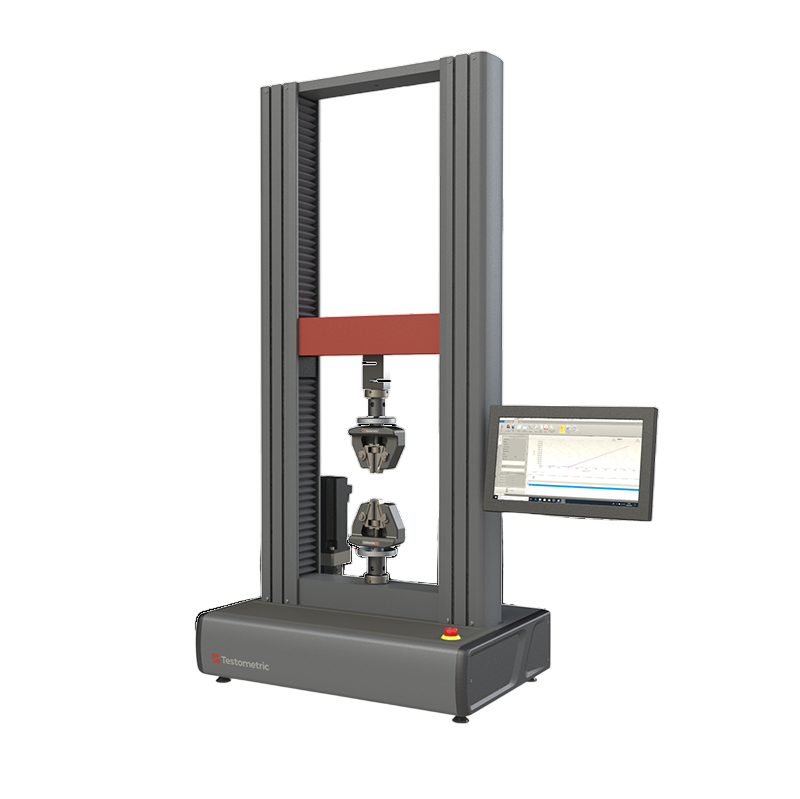
Testometric twin-column electromechanical UTM with a minimum 1,000 mm crosshead travel (essential for >800% elongation specimens). The X250, X350, and X500 bench-top series and XFS floor-standing series all support D412 with the correct grips and extensometer add-ons. The 1 kN – 50 kN force range covers the full spectrum of rubber compound hardness.
Grips
Testometric STR1 self-tightening roller grips (25 mm or 50 mm jaw width) are purpose-designed for rubber dumbbell specimens. Grip failure rate in typical ASTM D412 programmes drops from ~25% (standard wedge grips) to <5% with STR1 grips — dramatically improving throughput and data quality.
Extensometer
VE non-contact video extensometer (recommended) or DE-A3 long-travel contact extensometer (850 mm range). Both integrate with WinTest Analysis and carry calibration traceability to NPL/NIST. For NABL-accredited labs, the video extensometer avoids the clip attachment step, which reduces operator fatigue in high-volume QC testing.
Software
WinTest Analysis includes a pre-loaded ASTM D412 method template with automatic crosshead speed selection, break detection, M100/M200/M300 calculation, and one-click PDF/CSV report export. Template is fully editable for custom OEM specifications (e.g., specific modulus report points, batch statistics, watermark, logo).
- ±0.5% load accuracy across the full force range with 0.000001 mm position control resolution.
- Speed range 0.001–2,500 mm/min covers both 50 mm/min (TPE) and 500 mm/min (rubber) standard speeds from a single machine.
- 800% overload protection safeguards load cells from sudden fracture events common in tensile rubber testing.
- Crosshead travel up to 1,600 mm available on XFS series — accommodates even ultra-high-elongation silicone and latex specimens.
- Environmental chamber options (−70°C to +250°C) for heat-aging tensile retention testing and low-temperature brittleness per ASTM D2137.
- 500/1,000 Hz data acquisition rate captures the full stress-strain curve even at 500 mm/min.
- Supplied, installed, and serviced exclusively in India by FITCO: commissioning, operator training, spare parts, and complete after-sales support with a 2-year comprehensive warranty.
Best-fit Testometric models for ASTM D412
| Model | Force capacity | Best for |
|---|---|---|
| X250-1 kN | 1 kN | Soft silicone, latex, low-TS gum compounds, thin sheet |
| X250-2.5 kN | 2.5 kN | General NR/SBR QC, compound screening |
| X350-5 kN | 5 kN | Most rubber and TPE production QC (recommended default) |
| X350-10 kN | 10 kN | Hard compounds, polyurethane, reinforced rubber |
| X500-25 kN | 25 kN | High-load rubber-to-metal adhesion + tensile in same lab |
| X500-50 kN | 50 kN | Belt, hose, and cord-reinforced rubber products |
| Model | Force capacity | When to choose |
|---|---|---|
| XFS-100 kN | 100 kN | High-volume tyre compound labs, heavy rubber goods |
| XFS-150 kN | 150 kN | Belt carcass and cord-reinforced compound testing |
| XFS-300 kN | 300 kN | Structural rubber bearings, seismic isolator compounds |
Travel, column spacing, and speed ranges vary by configuration. Contact FITCO India for a tailored setup, grip quote, and WinTest ASTM D412 method template demonstration.
FAQs
Which die type should I use — Die C or Die B?
Default to Die C unless your customer specification states otherwise. Die C (25.4 mm gauge length, 6.35 mm waist) is the international reference die and provides the widest comparable dataset. Die B is used for micro specimens or limited compound availability — its narrower waist and shorter gauge length will produce different elongation values from the same compound.
Why do my specimens keep failing in the grip zone?
Grip-zone failure is almost always a grip selection or setup issue. Switch from wedge grips to Testometric STR1 self-tightening roller grips. If already using roller grips, check that the dumbbell tab is fully and symmetrically seated. Asymmetric grip seating creates bending in the shoulder radius and moves the failure location toward the jaw face.
Can I use crosshead displacement instead of an extensometer?
No — not for reported elongation values. ASTM D412 specifically states that elongation measured by crosshead travel is not equivalent to gauge-mark elongation due to grip compliance and specimen slippage. For internal QC screening this is sometimes done, but the report must clearly flag it as an estimated value. For any customer-facing compliance report or NABL accreditation, always use a calibrated extensometer.
How do I handle results below the M100 point?
If a specimen breaks before reaching 100% elongation, you cannot report M100. Report the tensile strength and elongation at break. This is common for very hard, low-elongation TPE compounds or highly filled compounds. If M100 is a contractual requirement, the specification may need to be revised or a different compound used.
What is the minimum number of specimens per lot?
ASTM D412 itself does not mandate a minimum number — it states "at least five specimens" are recommended. Most OEM incoming inspection specifications and QC plans require n = 5 minimum, with outlier rejection per ASTM E178 if one value lies more than 2 standard deviations from the mean. For compound development or lot-to-lot comparison, use n = 10 to improve statistical confidence.
Does ASTM D412 cover heat-aged specimens?
ASTM D412 is the test method; heat aging is a separate pre-conditioning step governed by ASTM D573 (oven aging) or ASTM D454 (air pressure aging). The rubber compound specification will state oven temperature, duration, and required percentage retention of tensile properties per D412 after aging. FITCO can advise on combined oven + UTM testing setups.
Do Testometric machines have pre-loaded ASTM D412 templates?
Yes. WinTest Analysis includes factory-built ASTM D412 Method A (Die C) and Method B (ring) templates with automatic break detection, M100/M200/M300 extraction, and one-click PDF or CSV report export. Templates can be customised for die type, speed, modulus report points, and company branding by FITCO during commissioning or via remote support.
How can FITCO help with ASTM D412 rubber testing?
FITCO India is the authorised distributor of Testometric UK universal testing machines. We supply Testometric UTMs to R&D centres, universities, institutes, and manufacturing brands — along with commissioning, operator training, spare parts, and complete after-sales support. Contact us to specify the right UTM, grips, and extensometer for your ASTM D412 testing programme.