
Large sheet tester for full-panel flexural testing.
The Testometric LST is a special system for flexural testing of large sheet materials such as fibre cement sheets, building panels, insulation panels, roofing panels and similar full-size products.
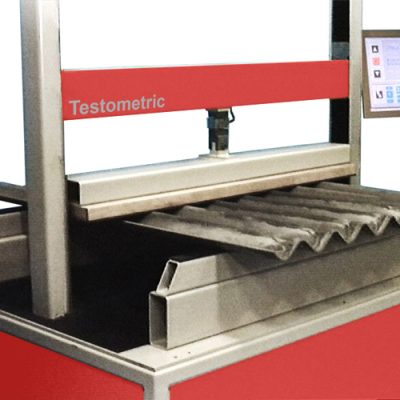

For sheet products that should be tested as panels, not small coupons.
Large sheet testing is useful when cutting small specimens loses the behaviour the customer cares about: panel span, edge condition, profile, construction, thickness variation or the way the sheet carries load across its full width.
- Fibre cement sheets, roof panels, insulation panels, building boards and similar sheet products.
- Flexural strength, load-deflection behaviour, stiffness comparison and failure mode recording.
- Product development, production QA, batch release, complaint investigation and certification testing support.
- Custom span, support and loading nose arrangements defined by the sheet geometry and standard.
Choose large sheet testing when the panel geometry is part of the result.
A normal UTM with small bend fixtures can be right for coupons. The LST route makes sense when the lab needs to support and load the real sheet size or a large representative panel.
| Choose LST if | Sheet width, length, profile, edge condition or span affects the measured flexural behaviour | Choose standard UTM if | Small coupons are acceptable and fit standard three-point or four-point bend fixtures |
|---|---|---|---|
| Most important geometry | Panel length, width, thickness, support span, loading nose width and support radius | Most important method detail | Conditioning, loading direction, span-to-thickness ratio, speed and failure definition |
| Main QA value | Realistic comparison of sheet strength, stiffness and failure across production lots or supplier changes | Main risk to control | Support misalignment, panel twist, edge damage, local crushing and unsafe fracture containment |
Specify the sheet envelope, then confirm force and fixture details.
Available public source material identifies the LST as a large-sheet flexural tester. The final configuration should be based on actual panel dimensions, span, expected break force and safety requirements.
| Test format | Full-sheet or large-panel flexural testing with application-specific supports and loading tool | Materials | Fibre cement, construction boards, insulation panels, roofing panels and similar products |
|---|---|---|---|
| Force measurement | Testometric platform force verification typically specified to Grade 0.5 / Class 0.5 where applicable | Load cell choice | Selected from expected break force and the need for useful low-force resolution |
| Extension measurement | Crosshead displacement plus optional deflection measurement where the standard requires panel deflection | Frame and support bed | Defined by panel size, span length, loading direction and operator access |
| Software | WinTest method control, curve capture, calculations, statistics, reports and data export | Safety | Guarding and handling plan for brittle fracture, large panels and operator loading |
Turn sheet flexural data into product decisions.
The machine should be configured around the decisions your team must make: product release, formulation change, reinforcement comparison, supplier approval or customer claim investigation.
Strength release
Use peak load, flexural strength and break location to release production lots against internal or customer limits.
Stiffness comparison
Use load-deflection curve slope, deflection at load and energy to compare constructions or thickness changes.
Failure diagnosis
Use photos, crack path, support marks and curve shape to distinguish brittle fracture, delamination, local crushing or fixture effects.
Method control
Use saved methods for span, speed, preload, calculation fields and report templates so operators do not reinvent the test.
Details needed before FITCO can size the large sheet tester.
- Maximum panel length, width, thickness, weight, profile and expected break force.
- Required standard, loading direction, support span, loading nose shape and support radius.
- Whether deflection must be measured at crosshead, sheet centre, multiple points or with external devices.
- Guarding, sample handling, floor space, operator access, report output and calibration requirements.
Questions buyers ask before specifying this Testometric system.
Use these answers to confirm whether this model, fixture package and WinTest method fit your lab or production workflow before quotation.
When should a large sheet tester be used?
How is it different from a standard bend fixture?
What details define the LST configuration?
Compare adjacent models before final selection.
Many special purpose projects overlap. These related pages help check whether force range, sample envelope, fixture geometry or throughput points to a better fit.
Wide Frame Tester
A Testometric wide frame system for large grips, platens, environmental chambers, bulky samples and wider working envelopes.
Glass Tester
A Testometric glass testing setup for building glass bend strength workflows using dedicated fixtures and method-controlled reporting.
Box Compression Tester
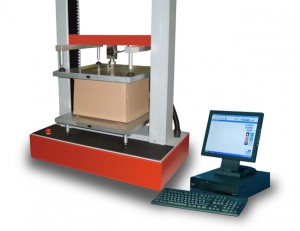
A Testometric box compression testing system for cartons, corrugated boxes, containers and package stacking validation.
Need to test sheets or panels at realistic size?
Send panel dimensions, material, required span, expected break force, standard and reporting needs. FITCO can specify the Testometric large sheet tester layout.