
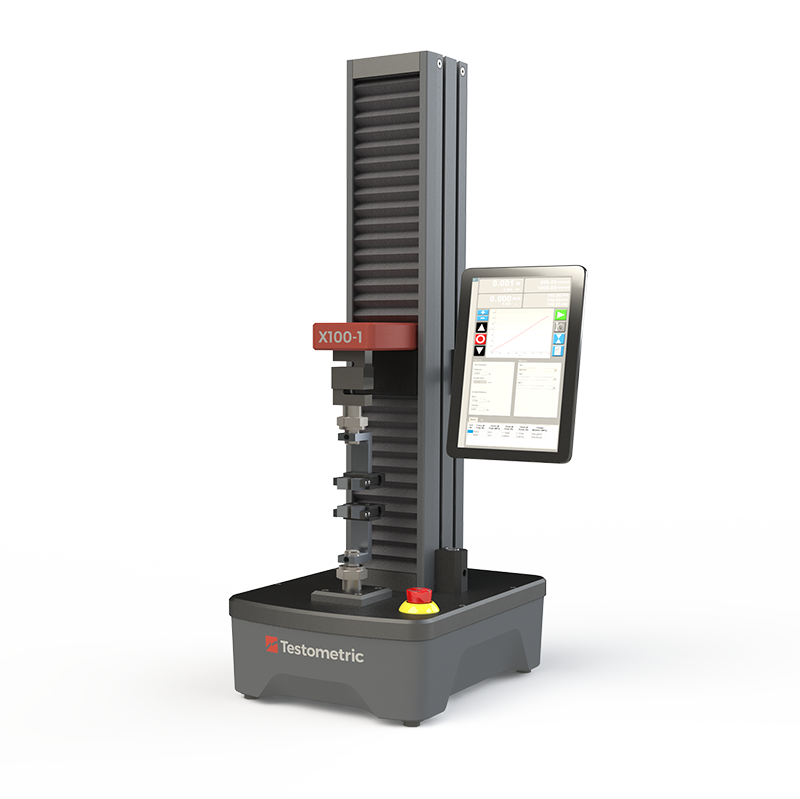
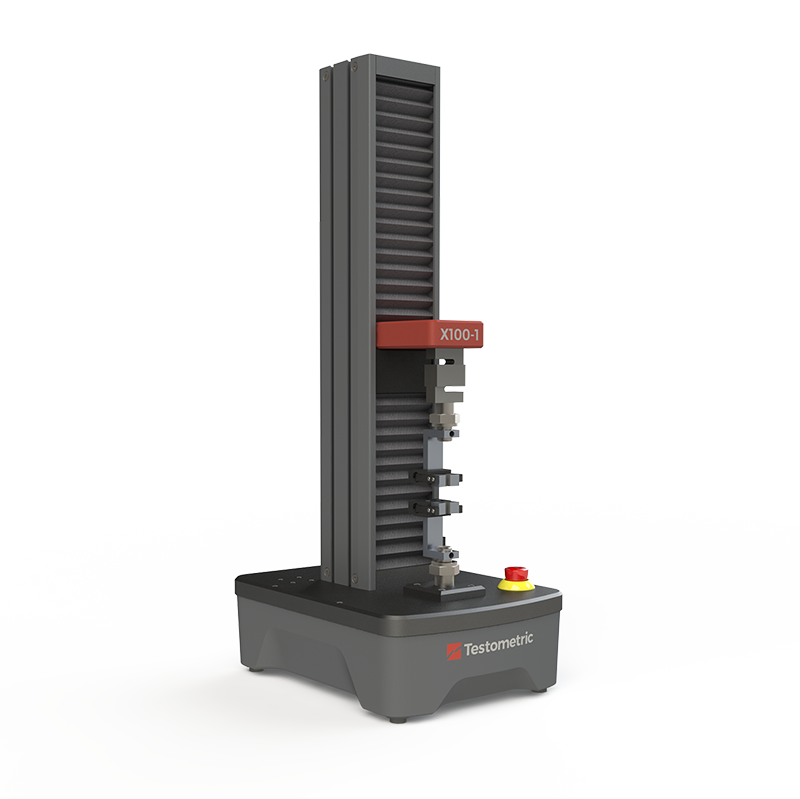
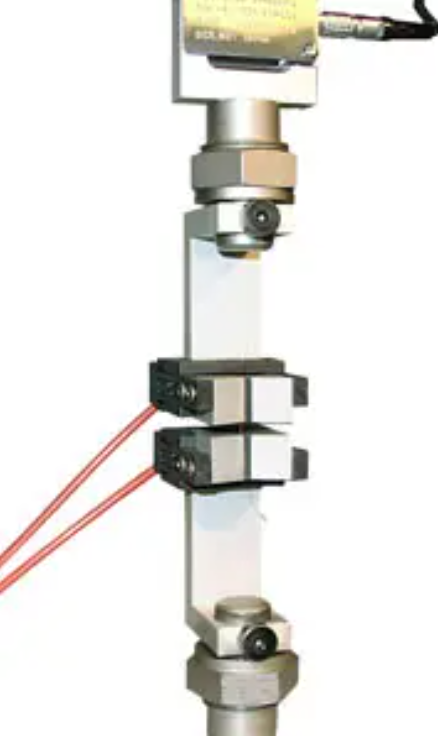
X100-FT single fibre tensile tester with pneumatic fibre grips.
A 1 kN X100-1 based fibre testing system supplied with a 500 cN load cell, PF1 pneumatic fibre grips and PF footswitch control for natural and synthetic single-fibre tensile tests.

For delicate fibres where grip pressure and gauge length control the result.
Single-fibre tensile testing is sensitive to handling, crimp, wet or conditioned state, pretension, fibre mounting and jaw pressure. The tester must hold tiny samples consistently before the software result means anything.
- Breaking force and elongation at break for individual natural and synthetic fibres.
- Conditioned or wet fibre testing where the method requires controlled state and gauge length.
- Tenacity, stress/strain and toughness calculations when fibre linear density or diameter is part of the method.
- Textile R&D, incoming fibre comparison, process studies and material development work.
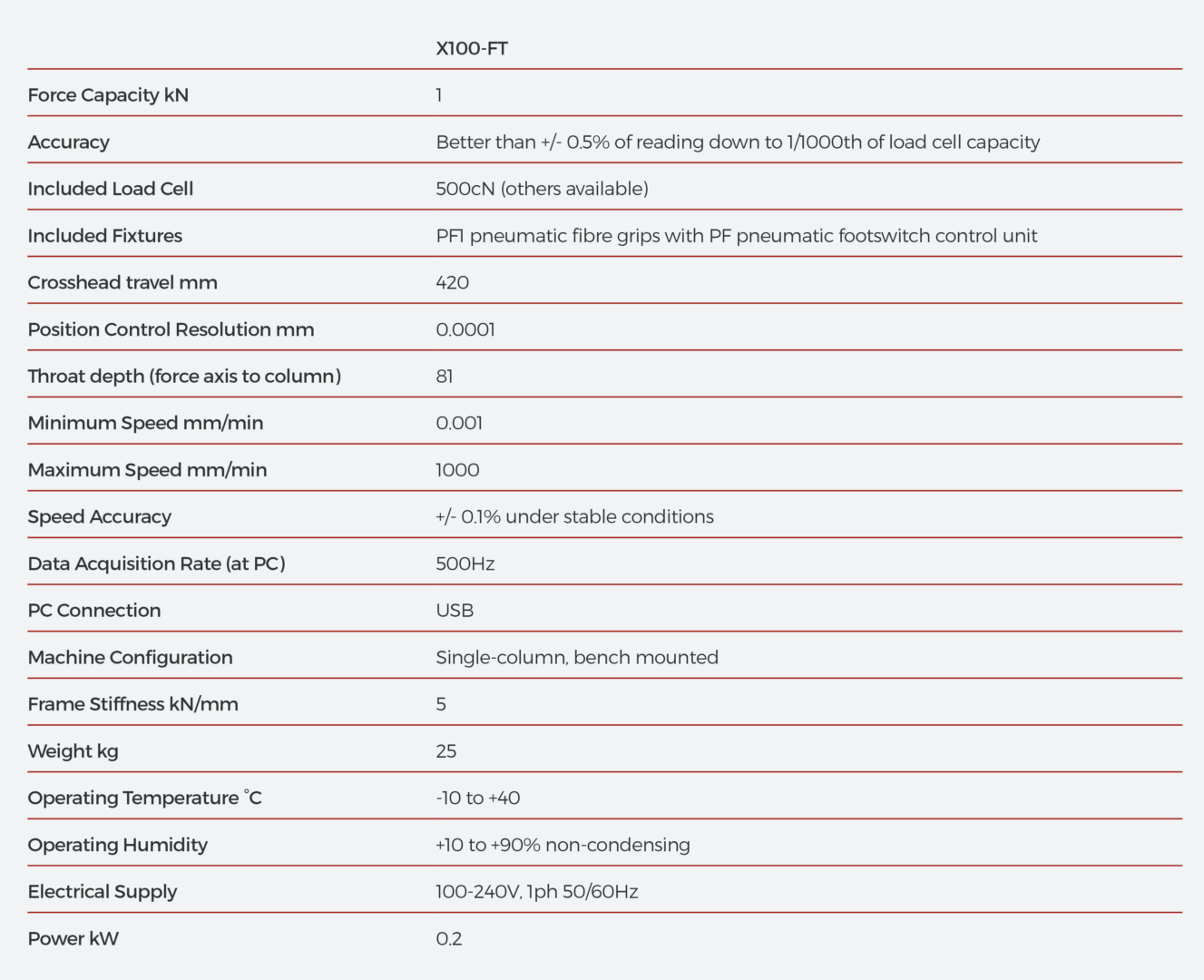
X100-FT configuration from the Testometric datasheet.
| Frame capacity | 1 kN | Machine type | Single-column, bench mounted |
|---|---|---|---|
| Included load cell | 500 cN, others available | Included fixture | PF1 pneumatic fibre grips with PF pneumatic footswitch control unit |
| Force accuracy | Better than +/-0.5% of reading down to 1/1000 of load cell capacity | Data rate at PC | 500 Hz through USB |
| Crosshead travel | 420 mm | Throat depth | 81 mm from force axis to column |
| Speed range | 0.001 to 1000 mm/min | Speed accuracy | +/-0.1% under stable conditions |
| Position resolution | 0.0001 mm | Frame stiffness | 5 kN/mm |
| Weight | 25 kg | Environment | -10 to +40 C, 10 to 90% RH non-condensing |
| Electrical supply | 230 V, 1 phase, 50/60 Hz; 115 V option | Power | 0.2 kW |
Use the correct fibre method for the sample state.
ISO 5079:2020
Determines breaking force and elongation at break of individual fibres in conditioned or wet state using constant-rate-of-extension testing.
ASTM D3822
Covers tensile properties of natural and man-made single textile fibres, including breaking force, elongation, tenacity, modulus and toughness calculations.
BS 3411
Legacy or customer-specified fibre testing workflows still appear in textile labs; confirm the exact part and customer requirement before method setup.
Force verification
Force measurement can be verified to ISO 7500-1 or ASTM E4 where the lab quality system requires traceable calibration.
Outputs that technical buyers expect from fibre tensile work.
Send these details before the grip and load cell are fixed.
- Fibre type, expected breaking force, gauge length, fibre length available and whether crimp is present.
- Conditioned or wet testing, pretension, jaw pressure, tab or mounting method and number of repeats.
- Whether tenacity, modulus or stress calculations require denier, tex, diameter or cross-section entry.
- Required standard version, calibration level, export format and report layout.
Questions buyers ask before specifying this Testometric system.
Use these answers to confirm whether this model, fixture package and WinTest method fit your lab or production workflow before quotation.
What is the X100-FT used for?
Which standards are relevant for fibre tensile testing?
What information is needed before quotation?
Compare adjacent models before final selection.
Many special purpose projects overlap. These related pages help check whether force range, sample envelope, fixture geometry or throughput points to a better fit.
Horizontal Tester
A horizontal Testometric testing system for long, heavy or flexible specimens such as ropes, cords, cables, webbing and assemblies.
Long Frame Tester
A Testometric extended-frame testing machine for long gauge length tests, high elongation materials and tall fixture stacks.
X100-TT Tissue Testing Machine
A dedicated Testometric X100-TT system for dry and wet tensile testing of tissue, hygiene paper and related low-force paper products.
Need single-fibre testing with the correct low-force setup?
Send fibre type, expected force range, gauge length, sample state, standard and output calculations.