
ASTM D882 – Tensile Testing of Thin Plastic Films
A complete method guide for film specimens, clamping, gauge length, extensometry, speeds, and analysis – engineered around Testometric UK universal testing machines and supported by FITCO India.
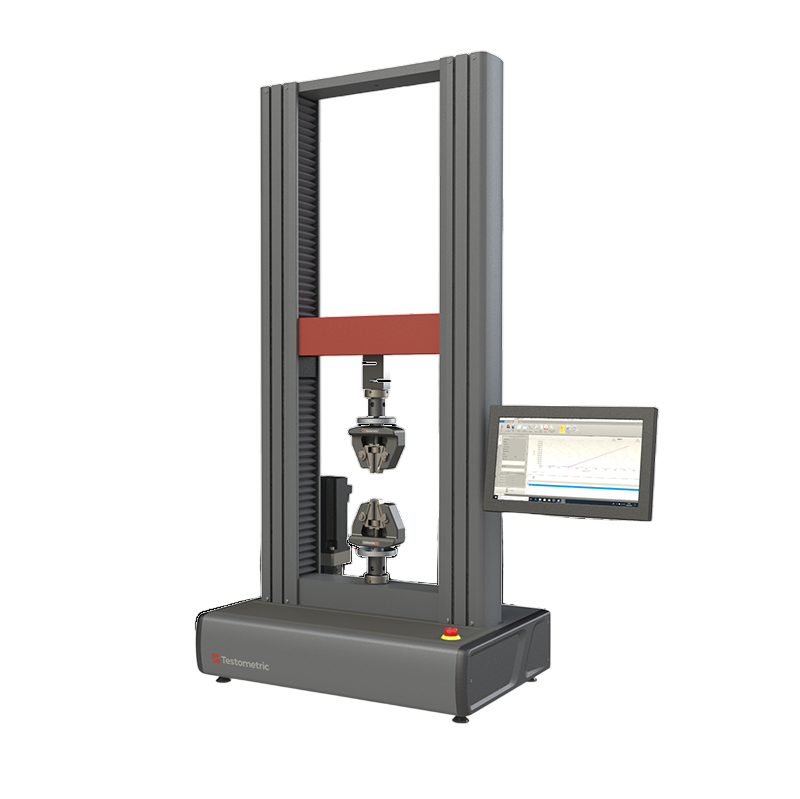
Overview
ASTM D882 defines the procedure to determine tensile properties of thin plastic films and sheeting. Key outputs include tensile strength, modulus, yield behavior, and elongation at break. Success hinges on consistent specimen preparation, film-friendly grips, and stable strain measurement.
Tip: For very thin films, use wide, cushioned jaws to distribute clamping pressure and avoid edge tears.
Industries & applications
Packaging
PET, BOPP, LDPE/LLDPE films. Focus on yield, elongation, and tear-related failures due to edge defects.
Electronics
Polyimide, PET dielectric films. Prioritize modulus and creep for dimensional stability.
Medical & pharma
Barrier films and pouches. Tight control of humidity and temperature for reproducible results.
Solar & display
Optical and encapsulant films. Ensure clean grips and avoid surface scratching.
Specimens
- Rectangular strips cut with clean, parallel edges; verify width with a calibrated gauge and measure thickness at multiple points.
- Condition at 23°C ± 2°C, 50% ± 5% RH unless otherwise specified; record dwell time.
- Use end tabs if required for very thin or delicate films to prevent grip damage.
Grip selection
- Pneumatic film clamps with rubber-faced or wave-pattern jaws reduce slippage and edge stress.
- Set clamping pressure to prevent slip without crushing; verify via pre-marked lines near the grip region.
- Maintain alignment to avoid bending; use self-aligning grips if available.
Instrumentation
- Load cell: choose capacity to keep peak forces within 10–90% of range for sensitivity and accuracy.
- Extensometer: clip-on with short gauge length or non-contact optical for precise modulus/yield; crosshead displacement for total elongation as appropriate.
- Data acquisition: = 10 Hz sampling; higher for brittle films or fast events.
Procedure
- Measure width and thickness; compute minimum cross-sectional area.
- Mount specimen with uniform clamping; set gauge length per method.
- Zero load and strain; run at specified crosshead speed to capture the full stress–strain response.
- Remove extensometer before break if required; continue to failure.
Calculations
- Stress: s = F / A0 (force over original cross-sectional area).
- Strain: e = ?L / L0 (change in gauge length over initial gauge length).
- Modulus: slope of the initial linear region of the stress–strain curve.
- Yield and elongation at break: per curve analysis and method definitions.
Reporting
- Specimen dimensions, conditioning, and number of replicates.
- Grip type, jaw faces, gauge length, and test speed.
- Environmental conditions and data sampling rate.
- Results: strength, modulus, yield, elongation; curves; statistics (mean, SD, CV).
Recommended Testometric setup
Frame
Testometric X-Series (e.g., X250/X350/X500) with high-resolution crosshead control for smooth speed ramps and excellent low-force sensitivity.
Grips
Pneumatic film clamps with cushioned/wave jaws; optional self-aligning mechanism for perfect alignment.
Extensometry
Short-gauge clip-on or optical extensometer integrated with WinTest Analysis for automatic modulus and yield detection.
Software
WinTest Analysis with ASTM D882 templates, batch reporting, and audit-ready exports.
- ±0.5% accuracy and 0.000001 mm position control resolution for tight modulus reporting.
- High-rate acquisition (500/1000 Hz) captures yield points and brittle breaks cleanly.
- 900+ grip options including film clamps, wedge and pneumatic grips; video extensometer integration for non-contact strain.
- Optional temperature control: environmental chambers from -165°C to +300°C.
- FITCO India support: installation, operator training, spares, after-sales, and 2-year comprehensive warranty.
Model suggestions for films
| X-Series model | Force capacity | Typical film use |
|---|---|---|
| X250-2.5 | 2.5 kN | Very thin films, low forces, fine resolution |
| X250-5 | 5 kN | General packaging films (LDPE, BOPP, PET) |
| X350-10 | 10 kN | Stiffer laminates, higher strength films |
| Accessory | Option | When to use |
|---|---|---|
| Grips | Pneumatic film clamps with rubber/wave jaws | Best for thin films; reduces slippage and edge tearing |
| Extensometer | Clip-on (short gauge) | High precision modulus/yield on ductile films |
| Extensometer | Video/non-contact | Very thin or delicate films; avoid mass loading |
Specifications vary by configuration; contact FITCO India for a tuned method and accessories aligned to ASTM D882.
FAQs
Edge breaks near grips?
Likely due to stress concentrations; add end tabs, reduce clamping pressure, or switch to cushioned jaws.
Film slips during test?
Increase pneumatic pressure incrementally and verify with alignment marks; use wave jaws.
How many replicates?
At least five per condition; more for brittle or highly variable films.
Need Help with ASTM D882 Film Testing?
Our experts can help you select the right Testometric UTM configuration, film grips, and extensometry for your thin plastic film testing requirements.