
GRC Testing Machines & Systems
Precision Universal Testing Machines configured for Glass Reinforced Concrete (GRC) — also known as GFRC. Run four-point bend tests for LOP, MOR, and Young’s Modulus, fully compliant with BS 6342 and the EN 1170 series. Trusted by GRC manufacturers, precast concrete producers, and test laboratories across India and globally.
GRC (Glass Reinforced Concrete), GFRC (Glass Fiber Reinforced Concrete), and GSFRC are different names for the same material — all tested to the same standards.
What Is GRC & Why Does Testing Matter?
Glass Reinforced Concrete (GRC) is a composite of Portland cement, fine aggregate, and alkali-resistant glass fibres. It is used extensively for architectural facades, cladding panels, street furniture, drainage channels, and decorative precast elements.
GRC vs GFRC vs GSFRC
GRC is the standard British/Indian term. GFRC (Glass Fiber Reinforced Concrete) is the equivalent North American term. GSFRC is an older technical designation. All refer to the same material and are tested to the same standards — BS 6342 and EN 1170.
Why Test GRC?
GRC mechanical properties — flexural strength, tensile strength, elastic modulus — degrade as glass fibres age in the cement matrix. Regular testing verifies the material still meets specification and ensures long-term structural safety of architectural cladding and infrastructure.
Key GRC Test Parameters
Critical measurements include LOP (Limit of Proportionality — first crack), MOR (Modulus of Rupture — peak strength), Young’s Modulus, tensile strength, and impact resistance (I-value) — all measured per BS 6342 and EN 1170.
GRC Testing in India
With India’s rapid growth in architectural precast, infrastructure, and facade systems, GRC testing demand is rising sharply. FITCO supplies and supports Testometric GRC test systems to manufacturers, R&D labs, and NABL-accredited test houses across India.
Precision GRC Testing Systems
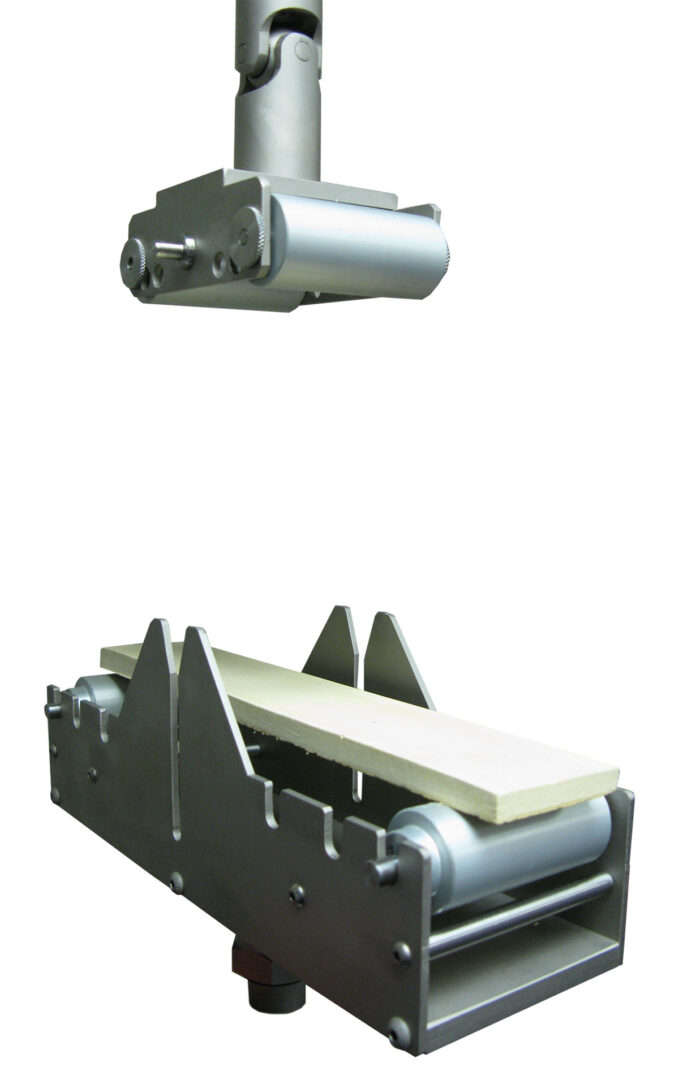
Precision-engineered Testometric Universal Testing Machines with specialised four-point bend fixtures and advanced LOP/MOR analysis software for GRC.
Load Capacity
High-capacity load cells for all structural GRC testing applications from thin sheet to full-size panels.
Speed Range
Variable speed control for flexural, tensile, and impact test methodologies per EN 1170 and BS 6342.
Accuracy
High precision ensuring reliable LOP and MOR measurements traceable to NABL/national standards.
GRC Fixtures
Custom 4-point bend fixtures, dog-bone grips, and impact attachments designed specifically for GRC specimens.
Why GRC Manufacturers Choose Testometric
Complete GRC testing capabilities covering all structural performance parameters required by BS 6342 and EN 1170, with pre-configured software built for GRC workflows.
LOP Testing (Limit of Proportionality)
Automated detection and calculation of the first-crack stress (LOP) with graphical analysis and quality control reporting for GRC mix optimisation.
MOR Testing (Modulus of Rupture)
Precise peak flexural strength measurements with dedicated GRC test setups and automated calculations per EN 1170-4 and EN 1170-5.
Young’s Modulus Determination
Elastic modulus calculation with strain measurement for comprehensive GRC material characterisation and stiffness assessment.
Impact Resistance (I-Value)
Charpy and drop-weight impact testing with I-value determination for GRC durability and performance assessment per EN 1170-6.
GRC-Ready Software
Pre-configured GRC test methods developed with leading GRC manufacturers — standardised templates for 3-point and 4-point bending, tensile, and impact modes.
Compliance Reporting
Automated BS 6342 / EN 1170 compliant report generation with full traceability, batch records, and export for NABL and third-party accreditation.
Advanced GRC Testing Capabilities
Beyond standard flexural testing — complete analytical capability for glass reinforced concrete research, QC, and specification compliance.
Multi-Point Data Acquisition
High-resolution data capture with synchronized strain and load measurement for detailed stress-strain curves and elastic behaviour analysis of GRC specimens.
Age-Testing & Environmental Conditioning
Temperature and humidity-controlled testing to simulate field aging of GRC — evaluating long-term glass fibre durability in the cement matrix.
Dimensional Stability Analysis
Precision measurement for tracking shrinkage and expansion characteristics critical for architectural GRC cladding panel fit and performance.
Fatigue & Cyclic Loading
Cyclic loading programmes for long-term GRC durability assessment, fatigue life prediction, and creep testing of structural GRC components.
Statistical Process Control
Integrated SPC modules with GRC production control charts, Cpk trend analysis, and automated alerts for continuous quality monitoring.
Automated Sample Sequencing
Programmable test sequences for high-throughput GRC sample batches with minimal operator intervention and enhanced repeatability.
GRC Testing Standards We Cover
Full adherence to British, European, ASTM, and ISO standards for GRC (Glass Reinforced Concrete) testing and construction quality assurance.
🏛️ GRC Core Standards
- BS 6342Specification for Glass Reinforced Concrete
- EN 1170-4GRC Tensile Strength
- EN 1170-5Determination of Modulus of Rupture (MOR/LOP)
- EN 1170-6Determination of Impact Strength
🔧 Testing Methods
- ASTM C947Flexural Strength of GRC (GFRC)
- ASTM C1230Glass Fiber Reinforced Concrete Spec
- ASTM C78Flexural Strength of Concrete
- BS 6432Methods for GRC Testing
🏗️ Construction Standards
- EN 1990Basis of Structural Design
- ACI 549.1RGuide for Fiber-Reinforced Concrete
- BS 8110Structural Use of Concrete
- Eurocode 2Design of Concrete Structures
✅ Quality Assurance
- ISO/IEC 17025Testing Laboratory Competence
- ASTM E4Force Verification of Testing Machines
- ISO 9001Quality Management Systems
- NABLNational Accreditation Board for Labs (India)
Complete Test Coverage for GRC Fabricators
From spray-up coupon testing to full-size panel bending — every mechanical property needed for specification compliance, mix optimisation, and QC sign-off.
Trusted by GRC Producers and Specifiers
GRC fabricators, precast concrete manufacturers, and test houses across India, the UK, and Asia rely on FITCO-supplied Testometric test equipment.
GRC Testing — Frequently Asked Questions
Common questions about GRC (Glass Reinforced Concrete) testing, standards, and equipment
GRC testing (Glass Reinforced Concrete testing) measures the mechanical performance of GRC panels and components — including flexural strength (LOP and MOR), tensile strength, elastic modulus, and impact resistance. It is required by BS 6342 and EN 1170 to verify that GRC product meets specification before use in architectural cladding, infrastructure, and structural applications.
Limit of Proportionality (LOP) is the flexural stress at the point of first crack in a GRC beam specimen. Modulus of Rupture (MOR) is the maximum flexural stress at failure. EN 1170-5 and BS 6342 require both values as primary indicators of GRC mix quality and glass fibre content. Higher MOR:LOP ratios indicate better fibre reinforcement.
All three refer to the same composite material — concrete reinforced with alkali-resistant glass fibres. GRC (Glass Reinforced Concrete) is the standard British and Indian industry term. GFRC (Glass Fiber Reinforced Concrete) is used in North America. GSFRC is an older academic/technical designation. All are tested to the same standards: BS 6342, EN 1170, and ASTM C947.
Yes. By repositioning the support spans and loading arrangement on the Testometric UTM, the same machine performs both test types for GRC specimens. Software templates automatically calculate LOP, MOR, toughness indices, and Young’s Modulus for each configuration.
GRC flat panels are cut into dog-bone or rectangular strip specimens and gripped in friction-grip or bonded-tab fixtures. Ultimate tensile strength, strain at peak load, and elastic modulus are computed per BS 6342 and EN 1170-4. This is essential for age-testing programmes monitoring fibre durability over time.
Yes. FITCO (Federal India Trading Company) is the authorised Indian distributor for Testometric UTMs. We supply, install, calibrate, and service GRC testing systems across India — including Mumbai, Delhi, Chennai, Bangalore, Hyderabad, Ahmedabad, and Pune. Contact us for pricing and delivery details.
Ready to Set Up GRC Testing?
Contact FITCO’s materials testing experts to discuss your GRC testing requirements — from single UTMs to complete lab setups with calibration and BS 6342 / EN 1170 compliance support across India.