
Overview & scope
ASTM D4595 wide-width geotextile testing and ASTM D4632 grab testing are not interchangeable: D4595 clamps the full 200 mm specimen width across a 100 mm gauge length to report true design tensile strength in kN/m, whereas D4632 clamps only a 25.4 mm central jaw area inside a 100 mm swath for index break load in newtons. In India, FITCO supplies Testometric X500-50 (50 kN), X500-100 (100 kN), and XFS (100 to 1,000 kN) UTMs with 200 mm hydraulic/roller grips and non-contact video extensometers; FITCO is not a contract testing lab.
ASTM D4595 determines engineering tensile strength (kN/m), elongation at peak load, and initial/offset secant tensile stiffness (kN/m at 2%, 5%, and 10% strain) across woven, nonwoven, knitted, and composite geotextiles used as load-bearing soil reinforcement.
Pulling a narrow strip of fibrous geotextile shrinks it laterally (Poisson necking), misrepresenting fabric stiffness in real wide-sheet embankments. Clamping a full 200 mm specimen width over a 100 mm initial gauge separation at 10 +/- 3 mm/min (10%/min strain rate) suppresses edge necking so results feed directly into geotechnical stability calculations.
Indian practice & BIS context
Indian highway (MoRTH, NHAI), railway (RDSO), and port infrastructure tenders specify BIS IS 16635 / IS 13162 alongside ASTM D4595, ISO 10319, ASTM D6241 (CBR Puncture), and ASTM D4884 (Seam Strength).
Industries & applications
MoRTH / NHAI Highway Retaining Walls
Qualifying high-strength woven PET and PP geotextiles up to 100-400+ kN/m without jaw slip or premature edge breaks.
RDSO Railway Formation & Sub-Ballast
Verification of wide-width tensile modulus (2% and 5% secant stiffness) paired with CBR plunger puncture (ASTM D6241 / ISO 12236).
Coastal Protection & Geotube Projects
Evaluating ultra-heavy knitted/woven tubes and factory sewn seams (ASTM D4884) requiring 100 kN to 600+ kN frame capacity.
Geosynthetic NABL & Third-Party QA Labs
Equipping single high-stiffness UTMs to transition cleanly between wide-width strip, grab, trapezoid tear, seam, and CBR fixtures.
Parameters & apparatus
| Parameter | ASTM D4595 Requirement | Testometric Hardware Configuration |
|---|---|---|
| Specimen Width & Gauge | 200 mm wide x 100 mm jaw separation | Extra-wide 200 mm jaw faces + >= 420 mm column clearance |
| Crosshead Speed | 10%/min nominal strain rate (10 mm/min) | Closed-loop +/-0.1% speed across full force build-up |
| Expected Force Span | 10 kN/m to >400 kN/m (2 kN to >80 kN peak on 200 mm) | X500-50 (50 kN), X500-100 (100 kN), or XFS-150 / 300 / 600 kN |
| Clamping Physics | High clamp force without cutting filaments at jaw line | 200 mm hydraulic wedge jaws (knurled/wave) OR roller capstan grips |
| Strain Measurement | Optional/advised optical tracking for modulus <5% | Testometric VE-XS1-M5 5MP DIC / VE2 non-contact video extensometer |
Test procedure
- Cut 200 mm MD & CMD swatches & condition: Cut minimum 6 machine-direction and 6 cross-machine specimens strictly parallel to yarn direction and soak wet/dry per spec (24 h wet saturation for wet tests).
- Seat full 200 mm width symmetrically: Align yarns straight across hydraulic serrated/wave faces or wrap uniformly around dual-capstan roller grips at exactly 100 mm gauge length.
- Zero preload & capture optical gauge marks: Apply standard preload (1% of estimated breaking force or 50 N minimum), lock non-contact video extensometer gauge targets, and initiate pull at 10 mm/min.
- Reject jaw-line failures & report kN/m: Compute tensile strength T = F_peak / 0.200 m in kN/m alongside 2%/5%/10% secant modulus, discarding slips or jaw cuts per method validity clauses.
Method comparison
| Dimension | ASTM D4595 Wide-Width | ASTM D4632 Grab Index | ISO 10319 Wide-Width |
|---|---|---|---|
| Clamped vs Specimen Width | 200 mm jaws on 200 mm full strip | 25.4 x 50 mm jaws on 100 mm swath | 200 mm jaws on 200 mm full strip |
| Gauge Length & Speed | 100 mm at 10 mm/min (10%/min) | 75 mm at 300 mm/min | 100 mm at 20 mm/min (20%/min) |
| Reported Unit | kN/m (design engineering unit) | Newtons / lbf (QC manufacturing index) | kN/m (IS 16635 aligned) |
| Interchangeability | Cannot convert to D4632 or ISO 10319 (2x rate) | Non-design QC index only | Speed difference moves strain-rate sensitive PP/PET |
Recommended Testometric setup
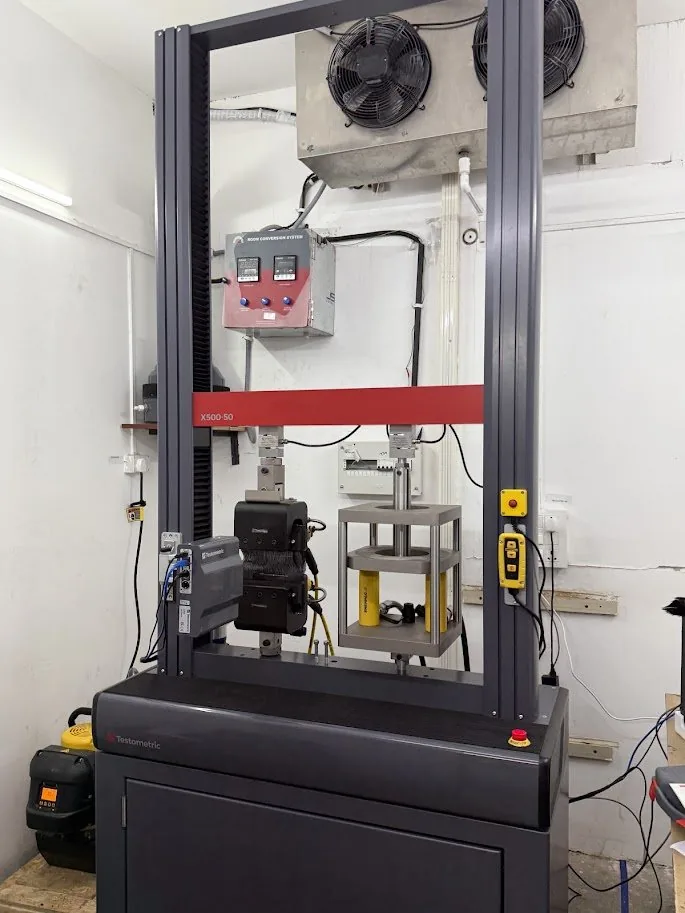
Testometric X500-50 / X500-100
High-stiffness twin-column benchtop UTMs (50 kN & 100 kN) with wide column daylight clearing 200 mm wide-width hydraulic grips and CBR puncture cages.
Testometric XFS-150 / 300 / 600 kN
Four-column floor-standing frames (100 to 1,000 kN) when ultra-high-strength woven polyester geogrids (>250 kN/m) exceed 100 kN on a 200 mm strip.
200 mm Hydraulic & Roller Grips
Variable-pressure hydraulic jaws prevent slip on slick PET tapes, while low-stress roller capstan grips eliminate sharp jaw cuts.
VE-XS1-M5 Video Extensometer
Tracks two optical targets inside the 100 mm fabric belly without contacting filaments, delivering clean 2% & 5% secant modulus curves.
- Single frame transitions cleanly across ASTM D4595 wide-width, ASTM D4632 grab, ASTM D4533 tear, ASTM D4884 seam, and ASTM D6241 CBR puncture.
- Class 0.5 load cell verification down to 1/1000 of rated capacity covers heavy reinforced woven belts down to lightweight nonwovens.
- Specified, commissioned, and calibrated across India by FITCO (est. 1950, Ahmedabad HQ).
Auditor failure modes
ISO/IEC 17025 and export customer audits routinely question test reports when four practical boundary mistakes occur:
- Trying to test >100 kN/m woven PET geotextiles using manual screw-wedge grips: Screw clamps lose bite as woven filaments thin under load; fibers slip asymmetrically until hydraulic pressure or capstan wraps are fitted.
- Serrated jaws shearing edge yarns right at the jaw face on 200 mm strips: Sharp pyramidal teeth slice brittle tapes before mid-gauge yield; use wave/corrugated faces, rubber liners, or capstan rollers.
- Using crosshead travel to calculate 2% / 5% secant modulus: Grip seating and roller take-up distort initial strain by >100%; non-contact video extensometry directly inside the 100 mm gauge is essential.
- Substituting ASTM D4632 grab tests in highway design filings: Grab testing pulls adjacent unclamped side fibres, inflating apparent strength; MoRTH/NHAI engineering specs require ASTM D4595 / IS 16635.
ASTM vs ISO equivalence warning
Method boundary ("Not Interchangeable"): Because specimen dimensions, conditioning relative humidity or cooling ramp rates, fixture mechanics, and reporting calculations differ across international and BIS methods, numerical results are not interchangeable and no empirical conversion factor satisfies an audit. Always prepare specimens and run the exact designation cited in your governing specification.
FAQs
Why do highway and infrastructure audits require ASTM D4595 wide-width results instead of ASTM D4632 grab numbers?
In ASTM D4632, unclamped side yarns carry part of the load into the 25.4 x 50 mm jaws, inflating the apparent break load in newtons. ASTM D4595 eliminates edge assistance by clamping the entire 200 mm specimen width across a 100 mm gauge length to measure true wide-width strength (kN/m) and secant modulus using hydraulic, capstan, or roller grips and non-contact video extensometry.
Which Testometric UTM capacity do I need for ASTM D4595 in India?
A 200 mm strip of a 200 kN/m geotextile reaches 40 kN nominal break load (plus dynamic safety factor), suited to a Testometric X500-50 (50 kN) or X500-100 (100 kN). For ultra-high-strength reinforcement fabrics above 400 kN/m, specify Testometric XFS-150, XFS-300, or XFS-600 floor-standing frames.
Are ASTM D4595 and ISO 10319 (IS 16635) interchangeable?
Both test 200 mm wide x 100 mm gauge strips and report kN/m, making them closely related geometrically; however, ASTM D4595 pulls at 10 mm/min (10%/min) while ISO 10319 pulls at 20 mm/min (20%/min), which raises apparent peak load in viscoelastic PP/PET fabrics.
When should I specify 200 mm hydraulic wedge grips vs capstan roller grips?
Select 200 mm variable-pressure hydraulic jaws for dense woven fabrics, nonwovens, and geocomposites requiring minimal specimen wastage; select roller/capstan grips when high-tenacity smooth PET tapes or brittle coated yarns break cleanly at the flat jaw edge.
Does FITCO supply geotextile testing machines or perform contract lab testing in India?
Federal India Trading Company (FITCO, established 1950, Ahmedabad HQ) supplies, installs, trains operators on, and services Testometric geosynthetic testing systems pan-India; FITCO is not a contract testing lab and holds no NABL accreditation.
Specifying instrumentation for ASTM D4595 in India?
Share your polymer/film structure, target standard revision, expected measurement range, and throughput with Federal India Trading Company (FITCO, established 1950, Ahmedabad HQ, +91 70165 47709, [email protected]). FITCO supplies, installs, commissions, trains operators on, and coordinates calibration verification for testing equipment across India and is not a contract testing laboratory.