
Small box compression tester for compact packaging QA.
A dedicated Testometric compression system for corrugated board boxes, cartons, containers, drums and smaller packaging formats where controlled platen movement, repeatable alignment and useful batch reporting matter.
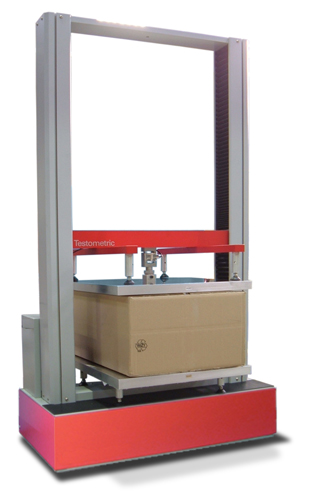
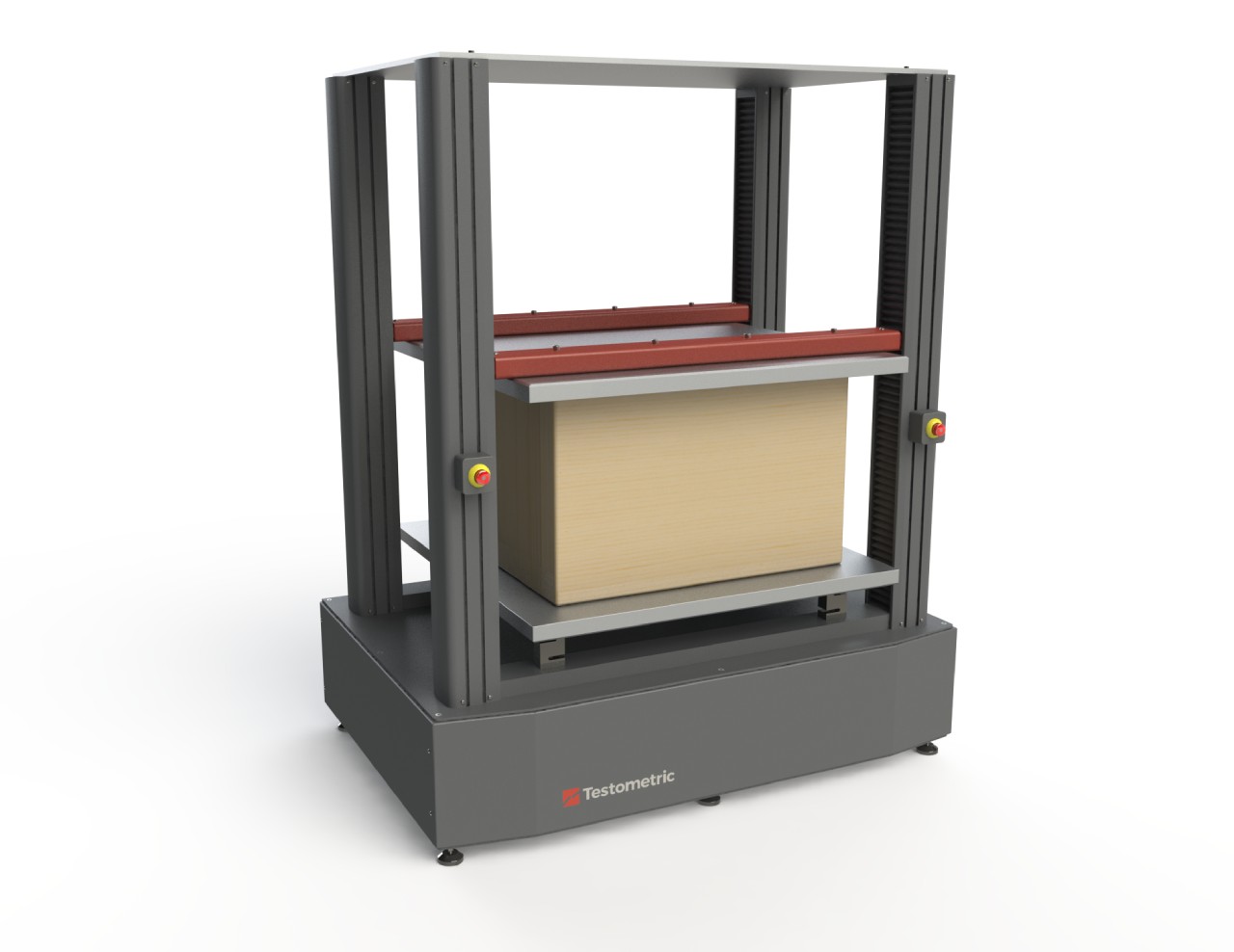

For small packaging formats where a full box-compression frame is unnecessary.
The small box compression tester is useful when the lab needs package strength data but the products are too small for a large floor-standing compression system. It keeps the test focused on platen alignment, load range, sample envelope and report consistency.
- Corrugated board boxes, cartons, containers, drums and compact packaging assemblies.
- Package crush load, collapse behaviour, deflection at load and stiffness comparison.
- Incoming packaging QA, supplier qualification, transit damage investigation and design validation.
- Controlled compression methods for routine batch release rather than occasional manual checks.
Choose the small-box system when size and load range match the real samples.
The right compression tester is not always the largest one. A compact system can give better day-to-day workflow when the sample footprint, expected force and platen opening are inside its useful range.
| Choose small box compression if | Your samples are cartons, small containers or packaging assemblies with modest footprint and force demand | Choose full box compression if | You need larger platens, larger daylight, palletized packs or high-load stacking simulations |
|---|---|---|---|
| Most important dimensions | Maximum box length, width and height, plus required platen travel after contact | Most important test setting | Compression speed, preload, end point, orientation and conditioning rule |
| Main QA value | Repeatable comparison of package strength and deformation across suppliers, designs and production batches | Main risk to control | Oversized samples, off-centre loading, poor closure consistency and humidity or preconditioning variation |
Legacy FITCO source blocks rebuilt into a practical specification checklist.
The current product source gives Testometric's standard force, extension, speed, load frame and WinTest software features. FITCO should confirm the final frame capacity, platen size and sample opening before quotation.
| Force measurement | Universally calibrated, better than Grade 0.5 to EN 7500-1, DIN 51221, ASTM E4 and AFNOR A03-501 | Load cell range | 0.4% to 100% minimum with automatic identification and electronic protection |
|---|---|---|---|
| Force resolution | 1 part in 500000 with autoranging | Extension measurement | Full frame length to 0.001 mm resolution, 0.01 mm accuracy and programmable limits |
| Speed control | Drive system temperature and current protection with jog speed from 0.001 mm/min to maximum | Load frame | Rigid frame, dual slide crosshead guidance, recirculating ballscrew and programmable safety stops |
| Software | WinTest Analysis for compression, tensile, peel, shear, tear, cyclic, creep and multi-stage methods | Data handling | Automated data storage and export to Word, Excel, Access or SPC systems |
Make compression results answer packaging questions.
Compression data is most valuable when the method defines what the lab is trying to decide: shipping risk, supplier approval, design change or batch release.
Stacking strength
Use peak load, load at deflection and collapse point to compare box designs or estimate safe stacking behaviour.
Supplier comparison
Use the same closure method, orientation, conditioning and speed so supplier batches are compared fairly.
Damage investigation
Use curve shape, failure mode, deformation and photos to separate weak board, poor design and handling damage.
Routine release
Use saved WinTest methods, pass/fail limits, batch IDs and export formats to make compression testing repeatable.
Send these details before FITCO quotes the small box compression tester.
- Maximum package length, width, height, weight and expected compression load.
- Required standard or customer method, sample orientation, closure method and conditioning rule.
- Platen size, required daylight, compression speed, end point and pass/fail calculations.
- Report fields, batch export, operator workflow, lab space, calibration and installation requirements.
Questions buyers ask before specifying this Testometric system.
Use these answers to confirm whether this model, fixture package and WinTest method fit your lab or production workflow before quotation.
What is the small box compression tester used for?
When should I choose full box compression instead?
What information is needed before quotation?
Compare adjacent models before final selection.
Many special purpose projects overlap. These related pages help check whether force range, sample envelope, fixture geometry or throughput points to a better fit.
Box Compression Tester
A Testometric box compression testing system for cartons, corrugated boxes, containers and package stacking validation.
X100-COF Coefficient of Friction Tester
A Testometric COF tester for static and dynamic coefficient of friction testing of films, paper, board, coated sheets and packaging surfaces.
Large Sheet Tester
A Testometric large sheet tester for full-sheet or large-panel flexural testing of building, roofing, insulation and fibre cement products.
Need compact compression testing for cartons or small packages?
Send box dimensions, expected load, standard, sample orientation and reporting needs. FITCO can confirm the right Testometric small box compression setup.