
What Is a Universal Testing Machine?
If you need the best UTM or tensile tester for plastics, packaging, rubber, pharma, metals, or medical testing — this guide covers how UTMs work, which standards apply, and exactly how to choose the right Testometric system for your lab.
Precision tensile and compression testing for plastics, packaging, rubber, metals, pharma, and medical applications.
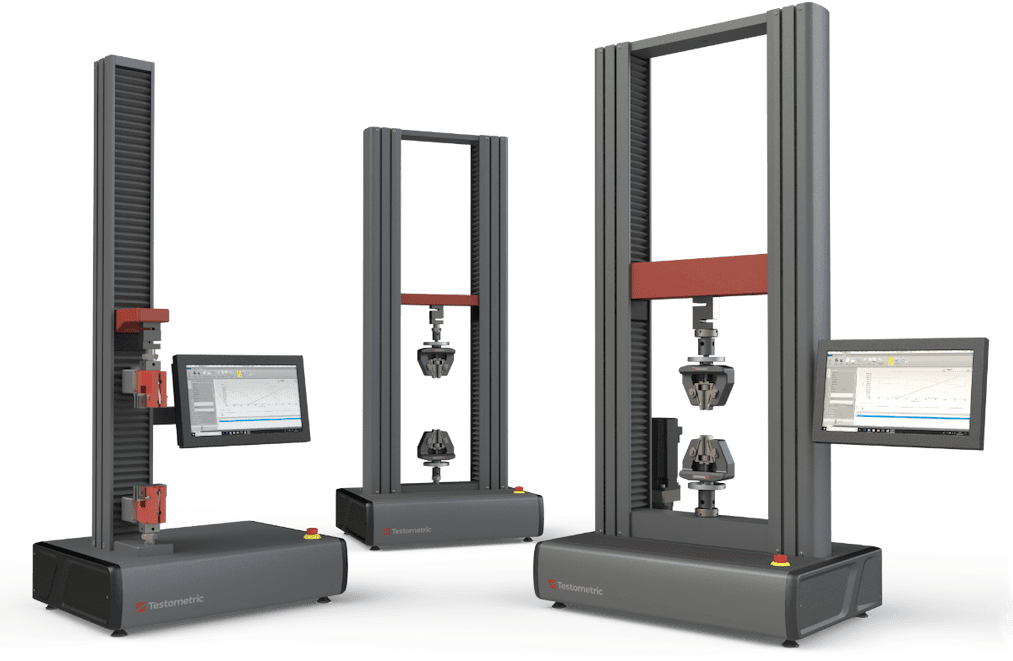
What is a UTM?
A universal testing machine, or UTM, is a materials testing system used to apply controlled force and movement to a specimen so you can measure tensile strength, elongation, compression behavior, peel strength, bond strength, flexural response, tear resistance, burst behavior, and more. In day-to-day industry language, it is also called a tensile tester, tensile testing machine, or universal tester.
The word universal matters because the same machine can perform many test methods by changing load cells, grips, fixtures, extensometers, software methods, and safety settings. That is why UTMs are used across plastics, packaging, rubber, medical devices, metal, automotive, textiles, paper, films, nonwovens, and R&D labs.
- Measures force, displacement, extension, stress, strain, and break behavior.
- Supports tensile, compression, bend, peel, tear, puncture, friction, and packaging tests.
- Can be configured for low-force lab work or high-force structural validation.
UTM vs tensile tester: what is the difference?
Most buyers use both terms interchangeably. Strictly speaking, a tensile tester is often a UTM configured mainly for tensile tests. A modern Testometric system can go far beyond simple pull tests, which is why many labs prefer to invest in a configurable UTM rather than a single-purpose machine.
Tensile tester
Usually refers to a setup optimized for tensile strength, elongation, yield, break load, seal strength, and pull-off testing.
Universal testing machine
Refers to a modular platform that can run tensile, compression, flexure, peel, friction, puncture, cyclic, and special-purpose tests.
How does a universal testing machine work?
A UTM uses a motor-driven crosshead, precision load cell, machine frame, grips or compression platens, and control software. The sample is mounted in the fixture, the test method defines speed and limits, and the machine records the load-versus-displacement or load-versus-strain response until the endpoint is reached.
- Select the right load cell and fixture for the specimen.
- Clamp or place the sample according to the standard.
- Run the programmed test speed and stop conditions.
- Generate results such as peak load, tensile strength, Young’s modulus, elongation at break, compression strength, peel force, or coefficient of friction.
Where are UTMs used?
Search demand for “best UTM” usually comes from buyers who need a machine matched to a specific application, not just a high force number. The right recommendation depends on material behavior, industry standard, and audit requirements.
- Plastics: tensile, flexural, compression, film, sheet, pipe, compound, and recycled polymer testing.
- Packaging: seal strength, peel, tear, puncture, box compression, top load, and closure performance.
- Rubber & elastomers: tensile strength, elongation, compression set related workflows, and grip-sensitive methods.
- Medical & pharma: syringes, catheters, sutures, blister packs, stoppers, plungers, peel-open packs, and FDA-auditable testing.
- Metals: tensile strength, yield, proof stress, bend, compression, and fastener testing.
- Automotive & composites: webbing, foam, trim, adhesive joints, and component validation.
How to choose the best UTM for your lab or plant
The best universal testing machine is the one that matches your force range, sample geometry, audit needs, and growth plan. Overbuying can waste budget. Underbuying creates poor accuracy, frame deflection, failed audits, and repeat purchases.
| Selection factor | What to ask | Why it matters |
|---|---|---|
| Force range | What is the lowest and highest load you test? | Accuracy and load-cell performance depend on staying in the correct operating window. |
| Frame type | Do you need benchtop, dual-column, or floor-standing? | Sample size, stiffness, and maximum force decide the machine architecture. |
| Test methods | Which ASTM, ISO, BIS, or pharma methods must you run? | Fixtures, extensometers, reports, and templates need to match the standards you audit against. |
| Software & compliance | Do you need 21 CFR Part 11, audit trail, IQ/OQ/PQ? | Essential for regulated labs and validated environments. |
| Crosshead speed | Do you run slow creep tests or high-speed packaging tests? | Speed range and speed accuracy affect method compliance and repeatability. |
| Fixtures & accessories | Will you test films, rigid plastics, metals, foam, sutures, paper, or boxes? | The machine is only as capable as the fixtures supplied with it. |
Recommended Testometric UTM range by application
Based on the current Testometric range promoted by FITCO India, these are the practical starting points for most buyers.
X100 / X250 Series
Ideal for lower-force materials testing, routine tensile work, medical packaging, and FDA-sensitive workflows where precision, compact footprint, and validation support matter.
X350 Series benchtop UTM
Strong fit for plastics, rubber, automotive components, flexible materials, and general QA labs needing versatile tensile and compression capability.
X500 dual-column systems
Recommended when you need higher stiffness, broader fixture compatibility, or dual-column confidence for demanding tensile and flexural methods.
XFS floor-standing UTM
Best suited for high-force applications, heavy samples, metals, structural components, and demanding production or certification environments.
XBC box compression systems
Purpose-built for corrugated box compression, top-load, packaging transit performance, and warehouse-ready carton validation.
FDA-compliant configurations
For medical device and pharma labs needing 21 CFR Part 11 workflows, electronic signatures, audit trail, and IQ/OQ/PQ validation support.
Why many buyers shortlist Testometric when searching for the best tensile tester
Search terms like “best tensile tester in the world” usually reflect buyer intent for reliability, software confidence, repeatability, and after-sales support. That is where Testometric and FITCO India can compete strongly: configurable platforms, broad force coverage, regulated-lab readiness, and application-driven guidance rather than one-size-fits-all selling.
- Wide force coverage from low-force lab testing to high-force structural testing.
- Benchtop, floor-standing, dual-station, box compression, and multi-tester options.
- Support for regulated workflows including FDA-focused validation requirements.
- Fit-for-purpose recommendations for plastics, packaging, pharma, automotive, metals, and composites.
- Local commercial and application support through FITCO India.
Common standards your UTM should support
Your article strategy should target real standards because high-intent buyers often search with the method name, not just the equipment name.
- ASTM D638 for plastic tensile properties
- ASTM D882 for thin plastic films
- ASTM D790 for flexural properties
- ASTM D695 for compression properties of rigid plastics
- ASTM F88 for seal strength of flexible barrier materials
- ASTM D642 for box compression testing
- ISO 527 for plastics tensile testing
- ISO 37 for rubber tensile testing
- ISO 6892 for metallic materials tensile testing
Buyer tip
If you are comparing UTM price only, you may miss the total cost of ownership. A lower-priced machine without the right grips, report templates, software validation, service response, or application know-how usually becomes the more expensive option over time.
Frequently asked questions
What is the use of a universal testing machine?
It is used to measure mechanical properties of materials and products under controlled load, including tensile strength, compression strength, elongation, peel force, bond strength, and flexural response.
What is the difference between a UTM and a compression tester?
A compression tester is typically focused on compression-only applications, while a UTM can usually run tensile, compression, bend, peel, tear, and other methods with the right fixtures.
Which UTM is best for plastics and packaging?
For many plastics and packaging labs, benchtop or dual-column Testometric systems are a strong fit because they cover tensile, seal strength, peel, puncture, flexural, and box compression related workflows.
Which UTM is best for FDA or medical device testing?
A system with validated software workflows, audit trail, electronic signatures, IQ/OQ/PQ support, and the right low-force accuracy is generally the correct choice. That makes FDA-oriented Testometric configurations especially relevant.
Need help selecting the right UTM?
Tell us your material, maximum force, test standards, sample dimensions, and audit requirements. FITCO India can help you shortlist the right Testometric solution for QA, R&D, packaging, medical, plastics, rubber, metal, or regulated lab testing.
- Benchtop and floor-standing UTM recommendations
- Fixture and grip selection support
- FDA and validation workflow guidance
- Model comparison across X100, X250, X350, X500, XFS, and XBC ranges