
ASTM D638 – Tensile Properties of Plastics
A complete lab guide to specimen Types I–V, dogbone geometry, grip selection, extensometry, crosshead speed, modulus calculation, and compliant reporting – engineered around Testometric UK universal testing machines and supported by FITCO India.
Overview & scope
ASTM D638 is the primary American standard for determining the tensile properties of unreinforced and reinforced plastics using standard dumbbell ("dogbone") specimens. It is maintained by ASTM Committee D20 on Plastics and is the default tensile reference for compounders, moulders, masterbatch producers, and NABL/ISO 17025-accredited laboratories across India and worldwide.
The standard reports tensile strength, tensile modulus, elongation at yield and break, and yield strength for rigid and semi-rigid plastics tested under controlled speed and environment.
Tip: ASTM D638 is intended for rigid and semi-rigid plastics. For thin films and sheeting under 1 mm, use ASTM D882 instead — the specimen geometry and gripping approach differ significantly.
What does it measure?
Tensile strength at yield and at break (MPa), tensile modulus of elasticity (MPa or GPa), percent elongation at yield and at break, and Poisson's ratio when biaxial extensometry is used. It does not measure flexural or impact behaviour — see ASTM D790 and ASTM D256 respectively.
Sample materials
Polypropylene (PP), polyethylene (HDPE/LDPE), ABS, polycarbonate (PC), nylon (PA6, PA66), POM, PET, PBT, glass-fibre reinforced compounds, and engineering thermoplastics — including recycled and compounded grades for QC.
Latest edition
Refer to the current ASTM D638 revision on astm.org and confirm the edition cited in your customer specification, as conditioning and speed references have been updated across revisions.
Industries & applications
Automotive & mobility
Under-bonnet components, interior trim, and GF-reinforced compounds — modulus and yield strength are critical to OEM approvals.
Packaging & FMCG
Rigid containers, closures, and crates. Tensile strength and elongation drive drop and stack performance.
Polymer compounding
Masterbatch and recyclate QC — D638 detects formulation and batch shifts before they reach production.
Electrical & appliances
Housings and structural mouldings where dimensional and mechanical reliability are specified.
Specimen types & geometry
ASTM D638 defines five specimen types (I–V). Type I is the default for rigid plastics ≥ 7 mm wide and ≤ 14 mm thick and should be used unless material thickness or availability requires another type.
| Type | Overall length (mm) | Gauge length (mm) | Narrow width (mm) | Typical use |
|---|---|---|---|---|
| Type I | 165 | 50 | 13 | Default — rigid plastics ~3.2 mm thick |
| Type II | 183 | 50 | 6 | When Type I fails in the tab; narrower waist |
| Type III | 246 | 50 | 19 | Thicker specimens (7–14 mm) |
| Type IV | 115 | 25 | 6 | Comparing rigid & non-rigid; limited material |
| Type V | 63.5 | 7.62 | 3.18 | Small samples, high-throughput screening |
Tip: Always state the specimen type in the report — modulus and elongation values from Type I and Type IV specimens of the same material are not directly comparable.
Specimen preparation
- Prepare specimens by injection moulding to the cavity dimensions of the chosen type, or machine them from sheet with smooth, defect-free edges.
- Inspect for sink marks, voids, flash, and weld lines in the gauge section — discard any specimen with visible defects.
- Condition at 23°C ± 2°C and 50% ± 5% RH for a minimum of 40 hours per ASTM D618 unless the material specification states otherwise.
- Measure width and thickness of the narrow section at three points with a calibrated micrometer (≤ 0.01 mm); use the minimum cross-sectional area for stress.
- Mark the gauge length for extensometer placement, avoiding scoring the specimen surface.
Grip selection
- Wedge action or pneumatic grips with serrated or rubber-faced jaws suit most rigid plastics; match jaw inserts to specimen thickness.
- Align the specimen on the load axis to avoid bending stresses that cause premature shoulder failures.
- For reinforced or high-strength compounds, use higher-capacity grips and confirm no slippage with pre-marked tabs.
- Discard results where the specimen breaks inside the grip or at the tab radius rather than the gauge section.
Instrumentation & extensometry
- Extensometer is mandatory for modulus. Crosshead displacement alone is not acceptable for tensile modulus reporting — machine and grip compliance distort low-strain data.
- Use a clip-on contact extensometer (e.g. 50 mm gauge for Type I) or a non-contact video extensometer for delicate or notch-sensitive materials.
- Select a load cell so peak force falls between 10% and 90% of rated capacity for best resolution.
- Sample at ≥ 20 Hz; increase for brittle materials that fail abruptly.
Test procedure
- Record temperature, humidity, and specimen identification for the batch.
- Verify current load cell and extensometer calibration; zero both channels.
- Mount the specimen squarely in both grips, aligned to the load axis without pre-stress.
- Attach or enable the extensometer at the marked gauge length.
- Run at the specified crosshead speed and acquire the full force–extension curve to break.
- Reject any specimen failing in the grip or tab radius and repeat on a fresh specimen.
- Export tensile strength, modulus, yield, and elongation with the curve for traceability.
Calculations & outputs
- Tensile stress: σ = F / A₀ — force divided by the original minimum cross-sectional area, in MPa.
- Tensile strength: the maximum stress sustained (at yield or at break, whichever is reported).
- Elongation / strain: ε = ΔL / L₀ — change in gauge length over the original gauge length, expressed as a percentage.
- Modulus of elasticity: the slope of the initial linear region of the stress–strain curve, requiring extensometer data.
Example: a Type I specimen with width 13.0 mm and thickness 3.2 mm has A₀ = 41.6 mm². At a peak force of 2,080 N, tensile strength = 2080 / 41.6 = 50 MPa.
Crosshead speed guidance
- 5 mm/min — standard speed for rigid Type I and Type II specimens.
- 50 mm/min and 500 mm/min — used for more ductile materials or where the specification requires faster rates.
- As specified — always follow the governing material or OEM specification and document the speed in every report.
Tip: Plastics are strain-rate sensitive — reporting a result without the test speed makes it impossible to compare across labs.
Reporting requirements
- Material identification, grade, lot/batch number, and moulding or machining method.
- Specimen type, individual dimensions, cross-sectional area, and number tested (with any rejected specimens and reasons).
- Conditioning, test temperature and humidity, crosshead speed, grip type, and extensometer type/gauge length.
- Results with statistics: tensile strength, modulus, yield strength, elongation (mean, SD, CV%).
ASTM D638 vs ISO 527 — key differences
Both standards measure tensile properties of plastics but use different specimen geometries and speeds, so results are not directly numerically comparable. Select the standard cited by your customer or target market.
| Parameter | ASTM D638 | ISO 527 |
|---|---|---|
| Primary market | Americas, global OEM | Europe, Asia, global OEM |
| Default specimen | Type I (50 mm gauge, 13 mm wide) | Type 1A/1B (multipurpose ISO 3167) |
| Conditioning reference | ASTM D618 | ISO 291 |
| Modulus strain range | Initial slope / chord | 0.05%–0.25% strain |
| Typical speed (rigid) | 5 mm/min | 1 mm/min (modulus), 50 mm/min (strength) |
Tip: If a specification simply says "tensile test," confirm ASTM D638 or ISO 527 before moulding specimens — the dogbone geometries differ and archived data will not be comparable.
Recommended Testometric setup
Frame
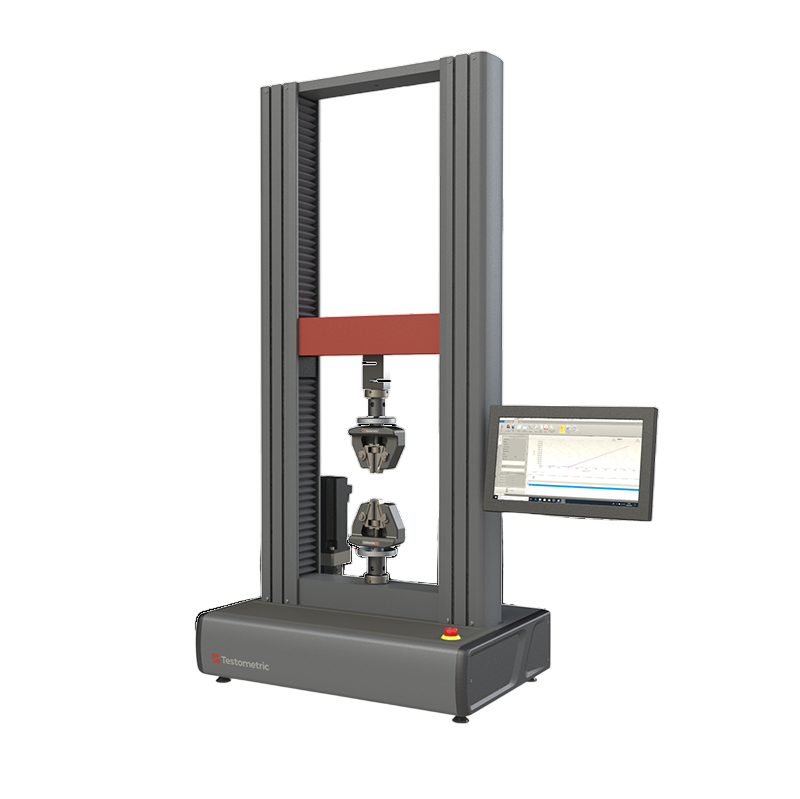
Testometric X-Series (X250/X350/X500) twin-column UTM with high-resolution crosshead control for precise modulus and yield capture.
Grips
Wedge-action or pneumatic grips with jaw faces matched to specimen thickness and self-aligning seating.
Extensometry
Clip-on (50 mm gauge) or non-contact video extensometer integrated with WinTest Analysis for automatic modulus detection.
Software
WinTest Analysis with ASTM D638 method templates, batch statistics, and audit-ready PDF/CSV exports.
- ±0.5% load accuracy and 0.000001 mm position resolution for tight modulus reporting.
- Speed range covering 1–500 mm/min for both ASTM D638 and ISO 527 methods on one machine.
- 900+ grip and accessory options including video extensometry for non-contact strain.
- Optional environmental chambers for elevated/low-temperature tensile testing.
- FITCO India support: installation, operator training, spares, after-sales, and 2-year comprehensive warranty.
Model suggestions for plastics
| X-Series model | Force capacity | Typical use |
|---|---|---|
| X250-5 | 5 kN | Unfilled commodity plastics (PP, PE, ABS) |
| X350-10 | 10 kN | Engineering thermoplastics (PC, PA, POM) |
| X500-25 | 25 kN | Glass-fibre reinforced and high-strength compounds |
Specifications vary by configuration; contact FITCO India for a tuned method and accessories aligned to ASTM D638.
FAQs
Which specimen type should I use?
Default to Type I for rigid plastics around 3.2 mm thick. Use Type IV for limited material or to compare rigid and non-rigid, and Type V for very small samples.
Can I report modulus without an extensometer?
No. ASTM D638 requires extensometer-measured strain for modulus; crosshead displacement includes machine and grip compliance and is not valid for modulus.
Why do specimens break at the shoulder?
Usually misalignment or sharp tab radii. Align on the load axis, check grip seating, and ensure smooth moulded radii. Grip/tab failures are discarded.
How many specimens per sample?
Test at least five; use ten for anisotropic or highly variable materials per the specification.
Is ASTM D638 the same as ISO 527?
They measure the same properties but use different specimens and speeds, so values are not directly comparable. Use the one your specification cites.
Related Standards
ISO 527-2
International equivalent for tensile testing of moulding and extrusion plastics.
ASTM D790
Flexural properties of plastics — pair with D638 for full mechanical characterisation.
ASTM D256
Izod impact resistance of plastics — complementary toughness property.
Need Help with ASTM D638 Plastic Tensile Testing?
Our experts can help you select the right Testometric UTM configuration, grips, and extensometry for your rigid and reinforced plastics testing requirements.