
Products Since 1950
Testing equipment, chosen by the question your lab has to answer.
Eight equipment families from six manufacturers, supplied and supported in India by FITCO. Each is listed with the standards it runs, the models to look at, what it cannot tell you, and the details FITCO needs to confirm the fit before you buy.
- Testing equipment and application support since
- 1950
- Manufacturers represented
- 6
- Equipment families on this page
- 8
- Target response to a complete brief
- 48 h
Products used by































































FITCO customers and worldwide users of our manufacturers’ equipment. Not all are FITCO installations.
All eight at a glance
Choose your testing equipment.
Match your ASTM, ISO or BIS test requirement directly to the physical property being measured: mechanical force and extension, gas or moisture permeation, polymer melt rheology, compression specimen moulding, heat-seal hot tack, pendulum impact energy or package leak and burst integrity.
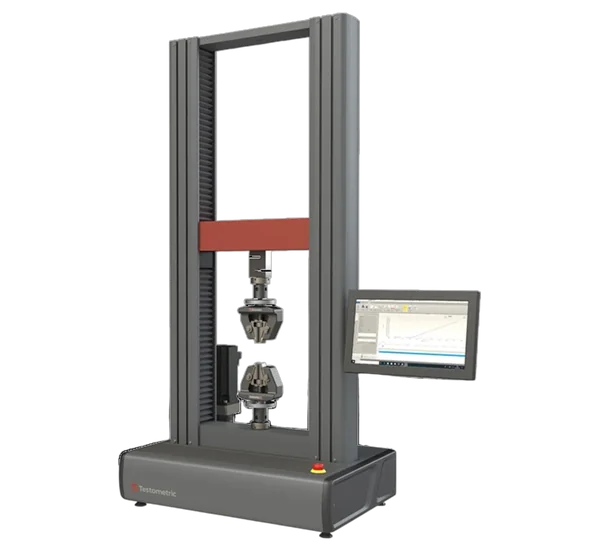 Universal testing machinesAlso called a tensile testerTestometric UKASTM E8, ASTM D638, ASTM D882
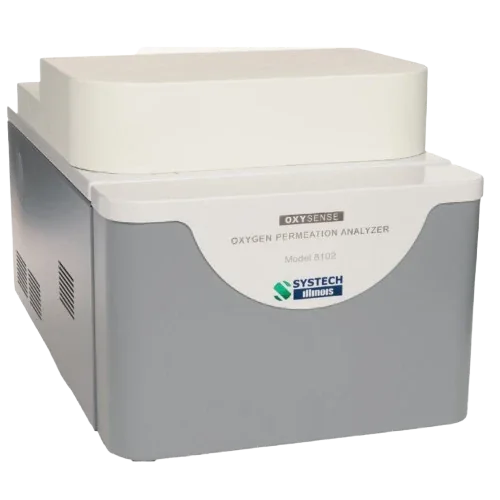 OTR and WVTR analysersSystech Illinois Industrial PhysicsASTM D3985, ASTM F1249, ISO 15105-2
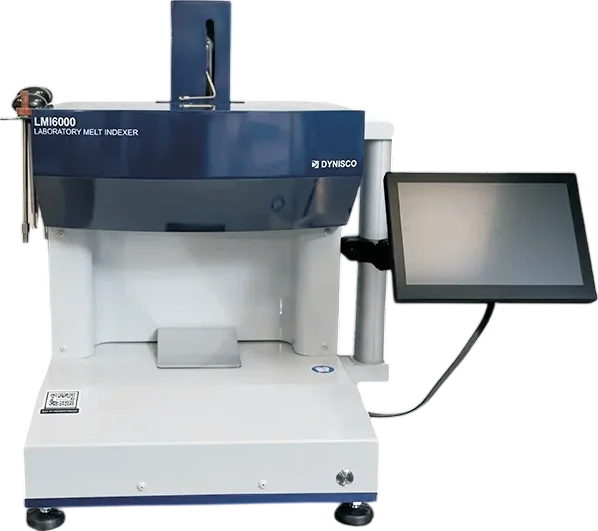 MFI testers and capillary rheometersDynisco USAASTM D1238, ISO 1133-1, ASTM D3835
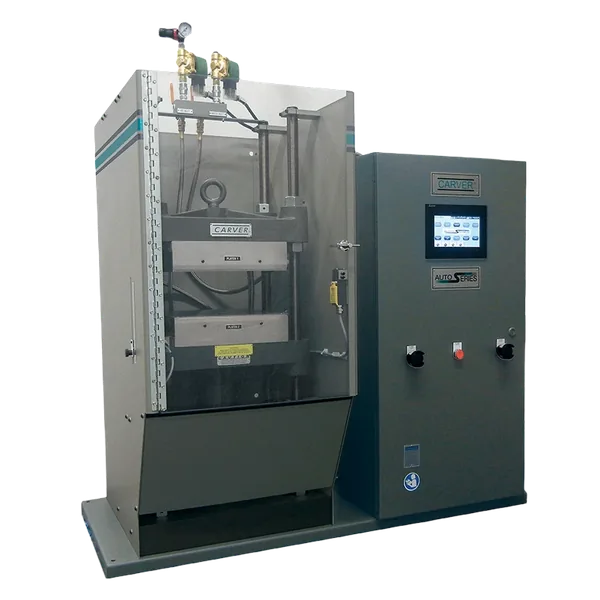 Laboratory pressesCarver USAASTM D4703, ASTM D3182
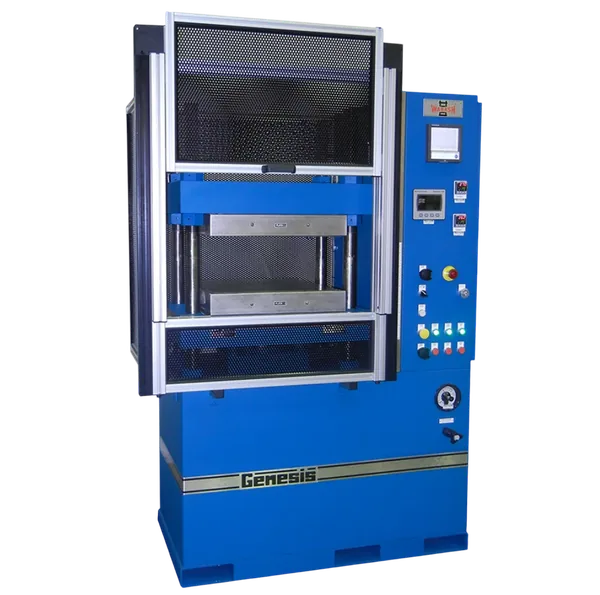 Compression and moulding pressesWabash MPI USAASTM D3182, ASTM D4703, ISO 293
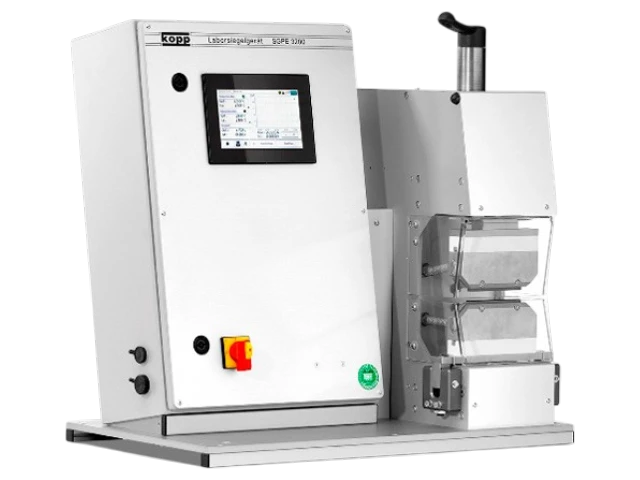 Heat sealers and hot tack testersWilli Kopp GermanyASTM F1921, ASTM F88, ASTM F2029
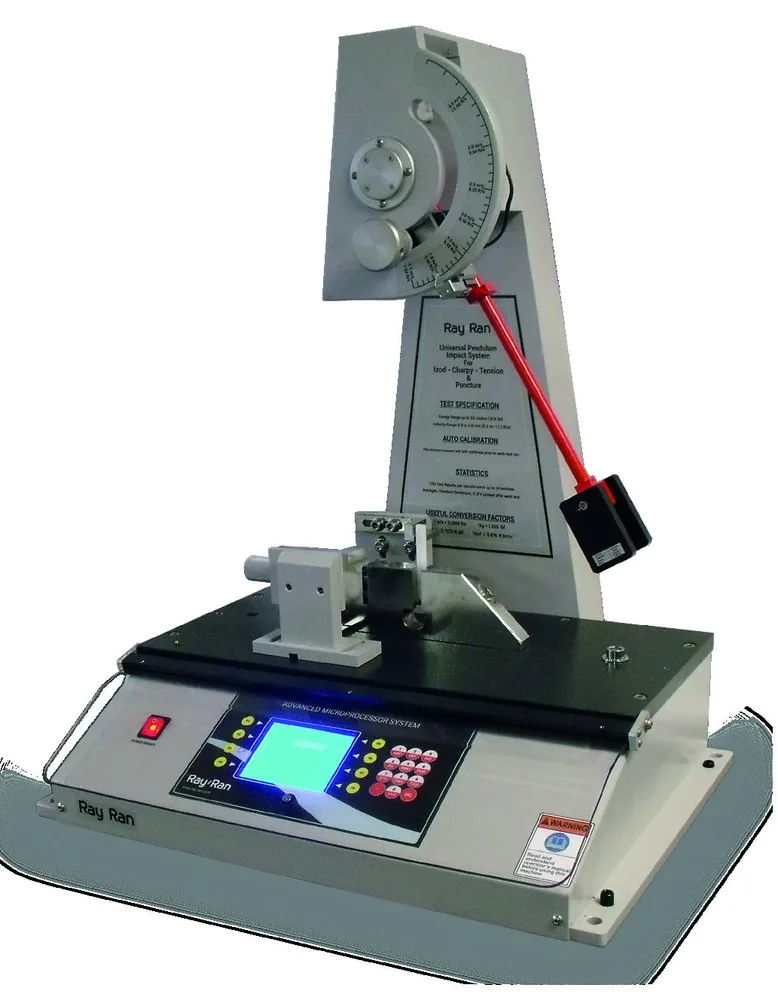 Pendulum impact testersRay-Ran Industrial PhysicsISO 179, ISO 180, ASTM D256
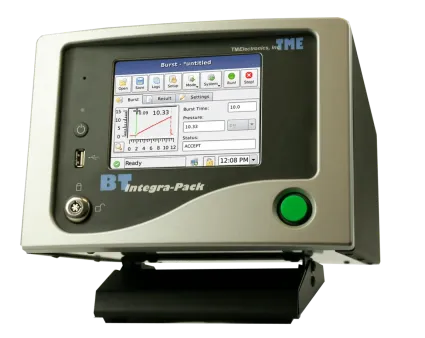 Leak and burst testersTME Industrial PhysicsASTM F2054, ASTM F2095, ASTM F1140
Equipment families
What each one measures, and which model to look at.
Ranges are from the manufacturers' published specifications and vary by configuration. FITCO confirms the model against your sample and standard before quoting.

01Force and extension
Universal testing machinesAlso called a tensile tester
Testometric UK
What load does the material carry, and how far does it stretch before it fails?
Tension, compression, flexure, peel and tear on one frame. Accuracy is better than ±0.5% of reading down to 1/1000 of the load cell capacity, with 500 Hz data acquisition as standard and 1000 Hz as an option.
| Series | Force capacity | Typical use |
|---|---|---|
| X100 | 1 kN | Films, fibres, medical micro-specimens |
| X250 | 1 to 3 kN | Textiles, foils, packaging, adhesives |
| X350 | 5 to 20 kN | Plastics, composites, rubber, cables, timber |
| X500 | 25 to 100 kN | Metals, aerospace, construction |
| XFS | 100 to 1000 kN | Steel, rebar, geogrids, heavy structures |
If the result you need is impact energy rather than load against extension, see pendulum impact.

02Oxygen and water vapour transmission
OTR and WVTR analysers
Systech Illinois Industrial Physics
How much oxygen or water vapour passes through the film or the finished pack?
Coulometric OTR and WVTR analysers for films, laminates, pouches, bottles and finished packs, plus a dynamic-humidity WVTR analyser for permeable materials. Choose by the transmission range you expect, then by sample format.
| Model | Range | Method and format |
|---|---|---|
| OxySense 8101e | OTR 0.05 to 432,000 cc/m²·day | ASTM D3985, RH control, 10 to 40 °C ±0.1 °C |
| OxySense 8102e | OTR 0.005 to 432,000 cc/m²·day | ASTM D3985, dry conditions, no RH control |
| AquaSense 7101 | WVTR 0.002 to 1000 g/m²·day | ASTM F1249, P₂O₅ coulometric sensor |
| Lyssy L80-6001 | WVTR 0.03 to 10,000 g/m²·day | ISO 15106, ASTM E398, dynamic RH sensor |
| OxySense 8700 / 8701 | 0.0004 to 2000 cc/pkg·day | Bottles (8700) or packs and films (8701), 11 cells, up to 66 |
| OxySense 8107e | 0.00001 cc/pkg·day resolution | Finished packs, up to 32 cells with satellites |
If the question is whether the pack leaks, not how fast gas permeates intact material, see leak and burst testing.

03Melt flow and rheology
MFI testers and capillary rheometers
Dynisco USA
Will this lot of resin flow like the last one, and how will it behave at process shear rates?
Melt flow indexers for MFR and MVR, capillary rheometers for full shear viscosity curves, and in-line sensors on the extruder. On the LMI 6000 with the digital encoder, PET intrinsic viscosity is correlated without solvents.
| Model | Method | Key figures |
|---|---|---|
| LMI 6000 Base | ASTM D1238 A, A/B, B, C; ISO 1133-1 | Weights placed by hand. Ambient to 400 °C (500 °C option), ±0.1 °C |
| LMI 6000 Multi-Weight | Adds Procedure D | Auto-Lift weight stack, 0.325 to 31.6 kg |
| LCR 7000 | ASTM D3835, ISO 11443 | 0.001 to 5,000 s⁻¹, to 30,000 psi (2,000 bar) |
| ViscoSensor | In-line on the extruder | Up to 400 °C, 4 to 20 mA or DCS output |
An MFI result is a single low-shear point. If the problem shows up on the line, read MFI or capillary rheometer below first.

04Specimen preparation
Laboratory presses
Carver USA
Can we make the same plaque or pellet every time, whoever runs the press?
Benchtop and floor-standing hydraulic presses from 15 to 100 tons for compression-moulded plaques, rubber specimens and KBr pellets. Automatic and programmable models reduce operator variation.
| Family | Capacity | Format |
|---|---|---|
| Auto Series Plus | 15, 25 and 30 ton | Benchtop, programmable microprocessor control |
| Monarch | 30, 50, 75 and 100 ton | Floor-standing hydraulic press |
| AutoPellet | Programmable force, dwell, decompression | Benchtop pellet press for FTIR and XRF |
| Manual benchtop | Unheated | Basic laboratory pressing |
Beyond 100 tons, or when the work needs vacuum or transfer moulding, look at Wabash MPI.

05Moulding and specimen preparation
Compression and moulding presses
Wabash MPI USA
Which press reproduces our moulding conditions, from trial plaque to composite layup?
Hydraulic, pneumatic, vacuum and transfer moulding presses, from benchtop up to several hundred tons of clamping force, with heated and optionally cooled platens and programmable pressure, temperature and time.
| Family | Drive | Used for |
|---|---|---|
| Genesis series | Hydraulic | Precision moulding and research |
| Vantage series | Hydraulic | Manufacturing and research |
| Vacuum moulding | Hydraulic with vacuum | Less trapped air in composite layups |
| Transfer moulding | Hydraulic | Rubber, silicone and composite parts |
| PNP series | Pneumatic | Pneumatic pressing |
For benchtop plaques and KBr pellets up to 100 tons, compare Carver first.

06Heat sealing and hot tack
Heat sealers and hot tack testers
Willi Kopp Germany
At what temperature does the seal start, and is it strong enough before it cools?
A laboratory sealer that makes repeatable seals at defined temperature, pressure and dwell time, and a hot tack tester that measures seal strength while the seal is still hot.
| Model | Type | Measures or makes |
|---|---|---|
| Labormaster | Hot tack tester | Hot tack strength, seal initiation, sealing window |
| SGPE | Laboratory sealer | Test seals at set temperature, pressure and dwell |
Hot tack and seal strength answer different questions. See the comparison below.
07Impact energy
Pendulum impact testers
Ray-Ran Industrial Physics
How much energy does the plastic absorb before it breaks?
Izod and Charpy pendulum impact testing for plastics, with notching cutters and sample cutting presses for specimen preparation.
| Equipment | Range | Role |
|---|---|---|
| Pendulum impact tester | 0.5 to 50 J | Izod and Charpy, impact velocity to 3.8 m/s |
| Notching cutter | Specimen preparation | Notches for notched impact specimens |
| Sample cutting press | Specimen preparation | Cuts test specimens |
For strength and elongation under a steadily rising load, see universal testing machines.
08Package integrity
Leak and burst testers
TME Industrial Physics
Will the sealed pack hold pressure, and if not, where and how fast does it leak?
Burst, creep-to-fail, leak, flow, occlusion and vacuum decay testing for flexible and rigid packs and components.
| Model | Key figure | Tests |
|---|---|---|
| BT Integra Pack | 0.001 psig leak resolution | Burst, creep-to-fail and leak |
| WORKER Integra | 0.0001 psig resolution | Leak, flow, occlusion, vacuum decay; flow to 10,000 SCCM |
| WORKER | Up to 300 psig | Production leak, flow and occlusion; stores 5,000 results |
To measure gas passing through an intact pack, see OTR and WVTR analysers.
Not interchangeable
Methods that look alike, and why they are not.
Most wrong purchases start with a method that sounded close enough. Find the question you are actually answering.
| If you need to know | Choose | Rather than | Why they differ |
|---|---|---|---|
| Will this resin run like the last one on the extruder or in the mould? | Capillary rheometer, ASTM D3835 | MFI alone, ASTM D1238 | MFI is one point at 1 to 10 s⁻¹. Extrusion runs at 100 to 1,000 s⁻¹ and injection moulding at 1,000 to 10,000 s⁻¹, so two resins with the same MFI can flow very differently in the mould. |
| Does the seal survive filling while it is still hot? | Hot tack, ASTM F1921 | Seal strength alone, ASTM F88 | Hot tack is measured immediately after sealing, before the seal cools. Seal strength is measured on a seal made for later evaluation. |
| What OTR will the finished pack deliver? | Package OTR, OxySense 8701 or 8107e | Film OTR, ASTM D3985 | Film OTR is reported per square metre of flat material, in cc/m²·day. A pack result is per package, in cc/pkg·day, and includes seals, closures and geometry. |
| Which WVTR analyser covers the range we expect? | AquaSense 7101 below 0.03 g/m²·day | Lyssy L80-6001 | The Lyssy L80-6001 starts at 0.03 g/m²·day and reaches 10,000; the AquaSense 7101 reaches down to 0.002 and tops out at 1000. Pick by the value you expect to measure. |
| MFR of a high-flow polyolefin above 50 g/10 min? | ASTM D1238 Procedure C | Procedure A | Procedure A, manual cut-and-weigh, suits 0.15 to 50 g/10 min. Procedure C uses a half-diameter, half-length die for high-flow polyolefins. |
| Flow rate ratio, as a check on molecular weight distribution? | LMI 6000 Multi-Weight, Procedure D | LMI 6000 Base | Procedure D runs several loads on a single charge and needs the Auto-Lift weight stack. On the Base, weights are placed by hand and Procedure D is not available. |
| Geotextile strength the design can rely on? | Wide-width, ASTM D4595 or ISO 10319 | Grab, ASTM D4632 | Grab and wide-width results differ for the same fabric and are not interchangeable. A narrow specimen necks down and reports a strength the fabric will not deliver in the ground. Case study |
What goes wrong
Eight ways a good machine produces a result nobody accepts.
Each of these is decided by the specification, before the purchase order. Each is checked in the FITCO Test-Fit.
Load cell sized to the frame, not the sample
Accuracy is specified down to 1/1000 of load cell capacity. On a 100 kN cell that floor is 100 N, so a film that breaks at 50 N is measured below it.
CheckSize the load cell to the working force window.
Extension that belongs to the machine
Frame stiffness runs from 5 kN/mm to 1300 kN/mm across the Testometric range. At high force, a compliant frame adds its own deflection to the extension you report.
CheckMatch frame stiffness and extensometry to the force.
The specimen breaks at the grip
A break at the grip edge, or one that starts from a nicked specimen edge, is a common reason a tensile result is rejected.
CheckConfirm grip faces and specimen cutting before the order.
MFR drifts with barrel temperature
For polypropylene or polyethylene, a 1.0 °C shift can change measured MFR by 5% to 10%.
CheckSpecify ±0.1 °C barrel control.
Wet PET reads a low IV
PET melted with more than 50 ppm moisture hydrolyses, chains shorten and intrinsic viscosity collapses.
CheckDry the sample, and record the drying, before testing.
A barrier rate reported too early
OTR and WVTR are only valid once permeation reaches steady state. Stop early and the reported value is still climbing.
CheckRun to equilibrium; Auto-Stop on the 8101e detects it.
Plaques with voids or uneven thickness
Voids, thickness variation and operator-dependent plaques usually trace to platen, mould, cooling or vacuum configuration more than to tonnage.
CheckSpecify the press around the material and mould.
Seals that open before they cool
A seal that opens, distorts or fails before it cools is not caught by a test on a cooled seal. Hot tack data separates material weakness from process settings.
CheckTest hot tack, not only seal strength.
The FITCO Test-Fit
Prove the test. Then buy the machine.
Confirmed before you buy. FITCO supplies, commissions and supports the equipment. FITCO is not a testing laboratory and does not hold NABL accreditation.
- Define the testMaterial, specimen, standard and revision, range, throughput and the result you need.
- Match the systemFamily, model, capacity, sensors, fixtures, software and accessories.
- Confirm the fitManufacturer review when the method, fixture or measurement range is uncertain.
- Install and supportCommissioning, operator training, warranty support and genuine spares across India.
Questions
Before you shortlist.
Which equipment do we need if we only know the material?
Start from the result you need rather than the material. Strength and elongation under load need a universal testing machine; barrier needs an OTR or WVTR analyser; resin flow needs an MFI tester or capillary rheometer; seal performance needs a heat sealer and hot tack tester; impact energy needs a pendulum impact tester; pack integrity needs a leak and burst tester. Send the material, specimen, standard and revision, and what the result is used for, and FITCO will narrow it from there.
Is a tensile tester the same as a universal testing machine?
In most Indian enquiries the two terms mean the same machine. Strictly, a tensile tester pulls only, while a universal testing machine runs tension, compression, flexure, peel and tear on one frame by changing the fixture and reversing the crosshead. The Testometric frames FITCO supplies are universal testing machines, so a frame bought for tensile work can take compression platens or a bend fixture later. What limits it is the load cell range, the fixtures and the crosshead travel, not the word used for it.
Do we need an MFI tester or a capillary rheometer?
An MFI tester measures flow under a single static load at low shear, 1 to 10 per second, which suits incoming resin checks and lot-to-lot consistency to ASTM D1238 and ISO 1133. Extrusion runs at 100 to 1,000 per second and injection moulding at 1,000 to 10,000 per second, where two resins with the same MFI can behave very differently. A capillary rheometer such as the Dynisco LCR 7000 measures the full viscosity curve to ASTM D3835 and ISO 11443.
What is the difference between heat seal and hot tack testing?
Heat seal testing creates controlled seals for later evaluation, for example seal strength to ASTM F88. Hot tack testing measures the strength of the seal immediately after sealing, while it is still hot, to ASTM F1921. Hot tack shows whether a seal can take stress on the filling line before it cools.
Does FITCO supply equipment or provide laboratory testing?
FITCO supplies equipment and provides application engineering, installation, training, warranty support and genuine spares across India. FITCO is not a testing laboratory and does not hold its own NABL accreditation. Discuss any calibration or accreditation requirements during specification so the proposed scope can be confirmed.
What should we send for a quotation?
Send the material, specimen dimensions, the test standard and revision, the expected range of the result, testing volume and any existing equipment. You do not need a complete specification to begin; FITCO can help identify the information needed to select a system. Each equipment family above lists the details that decide its configuration.
Talk to FITCO
Send the sample, the standard and the result you need.
+91 70165 47709[email protected]
Target response within 48 hours of a complete brief.
Browse by industry