
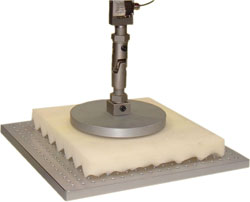
Foam seat tester for cyclic and indentation hardness testing.
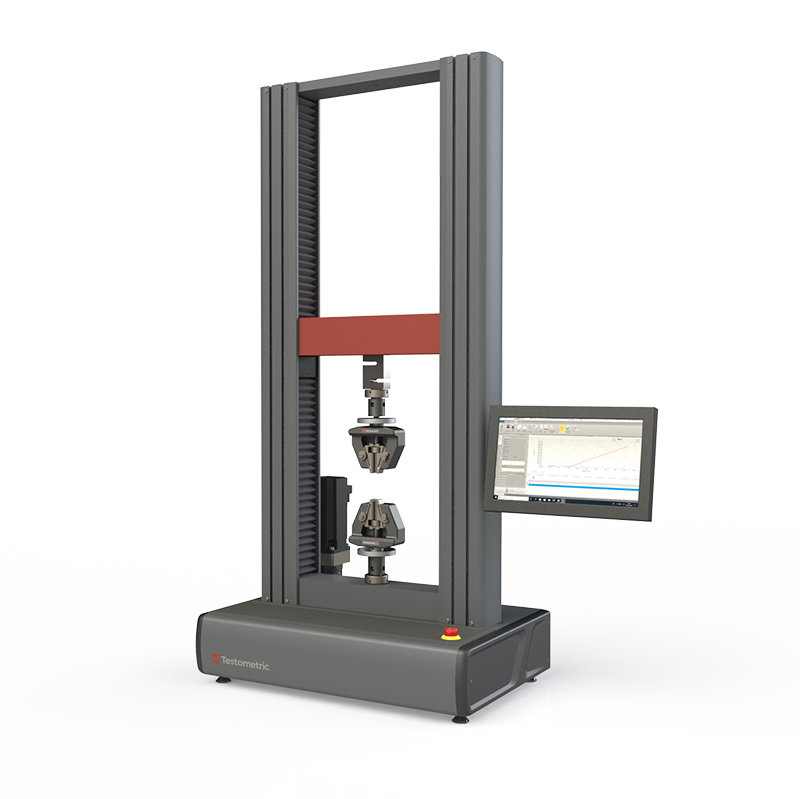
A special wide frame Testometric machine for foam and seating applications, used in automotive seat and furniture testing with software support for multi-stage cyclic and indentation hardness methods.

For foam products where comfort, resilience and deformation must be measured repeatably.
The foam seat tester is built for flexible foam and seating samples where a normal tensile frame does not provide the working width, platen package or method control needed for production QA and R&D.
- Automotive seat foam, furniture cushions, flexible foam blocks and seating assemblies.
- Multi-stage cyclic compression, conditioning, recovery and repeated loading workflows.
- Indentation hardness tests where platen shape, travel control and software method setup matter.
- Compression curves, hardness values, force at deflection, deflection at force and batch statistics.
Foam testing value comes from matching the result to the product question.
Seat foam and cushion foam can pass or fail for different reasons. Define whether the lab is controlling comfort feel, load support, fatigue change, resilience, supplier consistency or product validation.
| Comfort and support | Indentation force, hardness index, force at deflection and recovery behaviour | Useful for | Automotive seat feel, furniture cushion comparison and foam grade approval |
|---|---|---|---|
| Durability comparison | Cyclic force loss, set, hysteresis and curve change after repeated loading | Useful for | Seat validation, production change control and supplier qualification |
| Material development | Compression curve, modulus region, energy and recovery after dwell | Useful for | Foam formulation, density trials and process changes |
Configured around rigid or flexible foam standards and fixtures.
Testometric describes dedicated foam systems for rigid and flexible foam, including tensile, compression, shear, tear and indentation hardness testing. FITCO should confirm the actual standard, platen geometry, specimen conditioning and fixture package before quotation.
Compression
Controlled platen compression for foam blocks, cushions and seating samples with force-deflection reporting.
Indentation hardness
Dedicated fixture and software methods for indentation force, hardness and recovery workflows.
Cyclic testing
Multi-stage loading sequences for repeated seat foam checks, conditioning and durability-style comparisons.
R&D comparison
Useful for foam formulation, density trials, supplier comparison, batch release and product validation in automotive and furniture labs.
Measurement and control details exposed by the legacy FITCO product page.
| Force measurement | Universally calibrated, better than Grade 0.5 to EN 7500-1, DIN 51221, ASTM E4 and AFNOR A03-501 | Load cell range | 0.4% to 100% minimum with automatic identification |
|---|---|---|---|
| Force resolution | 1 part in 500000 with autoranging and electronic load cell protection | Extension measurement | Full frame length to 0.001 mm resolution, with absolute, relative and auxiliary modes |
| Speed control | Drive system temperature and current protection with 0.001 mm/min speed setting increments | Load frame | Rigid frame, dual slide crosshead guidance, recirculating ballscrew and programmable safety stops |
| Software | WinTest Analysis for tensile, compression, peel, shear, tear, cyclic, creep and multi-stage testing | Data handling | Automated data storage and export to common reporting or SPC workflows |
Confirm the standard before final fixture selection.
Foam testing can involve several standards depending on whether the sample is rigid foam, flexible foam, seat foam or a complete product. The list below reflects common foam standards published by Testometric and should be narrowed to your lab method.
Foam results are easy to distort unless the method is locked down.
For meaningful comparison, fix the conditioning, specimen dimensions, platen geometry, preload, dwell time, recovery time and number of cycles before using the machine for supplier or production decisions.
Conditioning
Temperature, humidity and recovery history can change foam response. Record the conditioning rule in the WinTest method.
Geometry
Specimen thickness, platen diameter and edge support affect force-deflection data. Keep them standardised within a product family.
Cycle definition
For seat foam, define the first-cycle treatment, target deflection, number of cycles, dwell and recovery before comparing batches.
Details needed for a meaningful foam seat tester quote.
- Foam type, sample size, seat assembly size and required working width or platen diameter.
- Required standard, cyclic sequence, indentation geometry, compression speed and recovery timing.
- Expected force range, travel range, number of cycles, data rate and result calculations.
- Report format, batch statistics, operator workflow, guarding and calibration requirement.
Questions buyers ask before specifying this Testometric system.
Use these answers to confirm whether this model, fixture package and WinTest method fit your lab or production workflow before quotation.
What does the foam seat tester measure?
Which foam standards may be relevant?
What controls foam test repeatability?
Compare adjacent models before final selection.
Many special purpose projects overlap. These related pages help check whether force range, sample envelope, fixture geometry or throughput points to a better fit.
X100-FTA Food Texture Analyser
A Testometric food texture analyser for shear, puncture, extrusion, compression and texture profile workflows using application-specific fixtures.
Spring Tester
A Testometric AT-S / CT-S spring tester for load-deflection, spring rate, free length and optional lateral force or vector diagram checks.
Wide Frame Tester
A Testometric wide frame system for large grips, platens, environmental chambers, bulky samples and wider working envelopes.
Need a foam tester for seats, cushions or flexible foam?
Send the foam sample size, required standard, cyclic method, expected force and result fields. FITCO can specify the Testometric frame, platen package and WinTest method.