
Spring tester for production and R&D spring validation.
Testometric AT-S and CT-S spring testers are dedicated systems based on Testometric universal testing machines, built to store and recall controlled methods for many spring references and generate load-deflection results without manual setup drift.
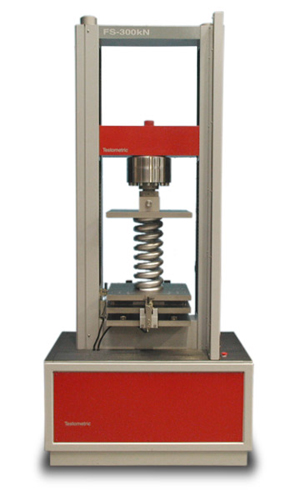
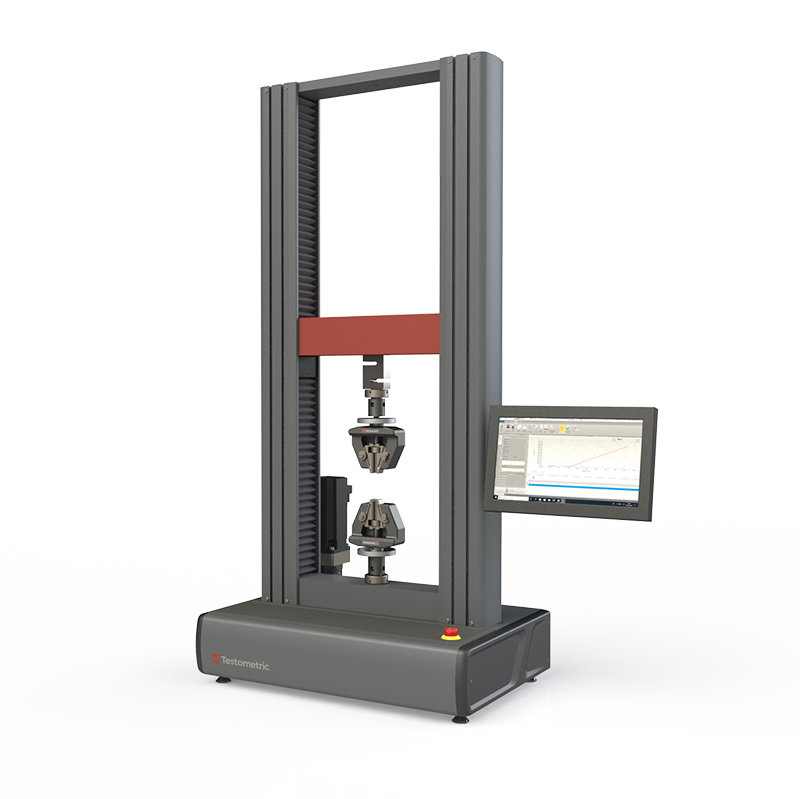

For spring checks where repeatable positions and stored recipes matter.
The spring tester is valuable when the same spring families are tested repeatedly in production or validation. Methods can be stored under spring references, recalled by operators, and run automatically to target positions or loads.
- Compression spring load-deflection testing, spring rate checks and free length measurement.
- Load at specified deflections, deflection at specified loads and multiple-rate calculations.
- Production release testing where highest, lowest and average statistics are needed during the run.
- R&D comparison of spring designs, materials, treatments, set behaviour and tolerance bands.
Choose the spring tester by force range, spring geometry and result type.
A spring tester is not just a compression frame. The useful configuration depends on whether the lab needs simple axial load-deflection data, production recipes, lateral force information, or vector diagrams for levelling characteristics.
| Choose AT-S / CT-S if | You need dedicated stored methods for many spring references, automated position control and spring-specific calculations | Use standard UTM if | The spring test is occasional, low complexity and does not need recipe recall or spring-specific fixtures |
|---|---|---|---|
| Most important geometry | Free length, outside diameter, solid height, working deflection, seating surface and maximum compression travel | Most important force detail | Expected working load, proof load, load cell range and required resolution at low forces |
| Advanced requirement | Secondary load cells can measure lateral forces and produce vector diagrams for spring levelling characteristics | Main risk to control | Misalignment, poor seating, buckling, over-compression and using one load cell for too wide a force range |
Dedicated spring testing behaviour with Testometric measurement control.
The legacy FITCO source describes AT-S and CT-S models with method storage for several thousand spring types, real-time load-deflection plotting, built-in statistics, factory-floor reporting without a PC, and capacities from 100 N to 600 kN.
| Model family | Testometric AT-S and CT-S dedicated spring testers based on AT and CT universal testing machines | Capacity range | Available from 100 N to 600 kN, selected to spring load range |
|---|---|---|---|
| Method storage | Controlled test methods stored and recalled by spring reference for many spring types | Run control | Automatic control to desired positions or loads with calculations and results produced by the method |
| Force measurement | Universally calibrated, better than Grade 0.5 to EN 7500-1, DIN 51221, ASTM E4 and AFNOR A03-501 | Load cell handling | Automatic identification, autoranging, 1 part in 500000 resolution and electronic protection |
| Extension measurement | Full frame length to 0.001 mm resolution with programmable extension limits | Speed control | Drive system protection with jog speed from 0.001 mm/min to maximum |
| Display and reporting | Real-time load-deflection plot, free length, load/deflection results, spring rates and live statistics | Software | WinTest Analysis methods, data storage and export to Word, Excel, Access or SPC systems |
Make spring results useful for production decisions.
Spring testing is useful only when results map to a tolerance decision. Define the target positions, loads and rates before building the method, then lock those fields into operator routines.
Production release
Use load at specified height, height at specified load, free length and pass/fail limits for routine batch decisions.
Rate control
Use spring rate between two forces or two deflections to compare stiffness across heat treatment, wire batch or design changes.
Levelling checks
Use lateral force and vector diagrams where spring seating, squareness or off-axis behaviour affects assembly performance.
R&D comparison
Use full load-deflection curves, proof cycles, set behaviour and statistics to compare prototype designs before release.
Control the setup before comparing springs.
Small differences in seating, preload and end-point definition can change spring results. FITCO should confirm fixture style, platen alignment and calculations during method setup.
Send these details before FITCO quotes the spring tester.
- Spring type, free length, outside diameter, solid height, wire diameter and expected working load.
- Required results: load at height, height at load, spring rate, proof load, set, lateral force or vector diagram.
- Number of spring references, production throughput, operator workflow and whether PC-free floor reporting is needed.
- Fixture style, platen size, guarding, calibration requirement, report format and data export needs.
Need a spring tester for production or R&D?
Send spring drawings, force range, test positions, required calculations and throughput. FITCO can map the right Testometric AT-S or CT-S configuration.