
X500MS multi station tester for repeat QA workflows.
A twin-column, bench-mounted Testometric platform configured for repeated production or laboratory tests where multiple stations, fixtures and methods must run with controlled data capture.
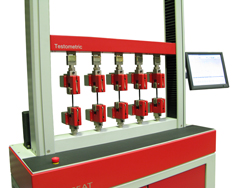

For repetitive tests where throughput is the problem, not force capacity.
A multi-station machine makes sense only when the workflow is defined: same method across multiple specimens, repeated component checks, long test times, or fixtures that can be staged to reduce operator waiting.
- Production QA where the same tensile, compression, peel, puncture or product test is repeated all day.
- Batch comparison where station layout reduces sample loading time and keeps reporting consistent.
- Medical, packaging, textile, polymer and component workflows needing dedicated stations or custom jigs.
- R&D or validation labs where method storage, traceability and operator consistency are more valuable than manual flexibility.
X500MS platform and specification inputs.
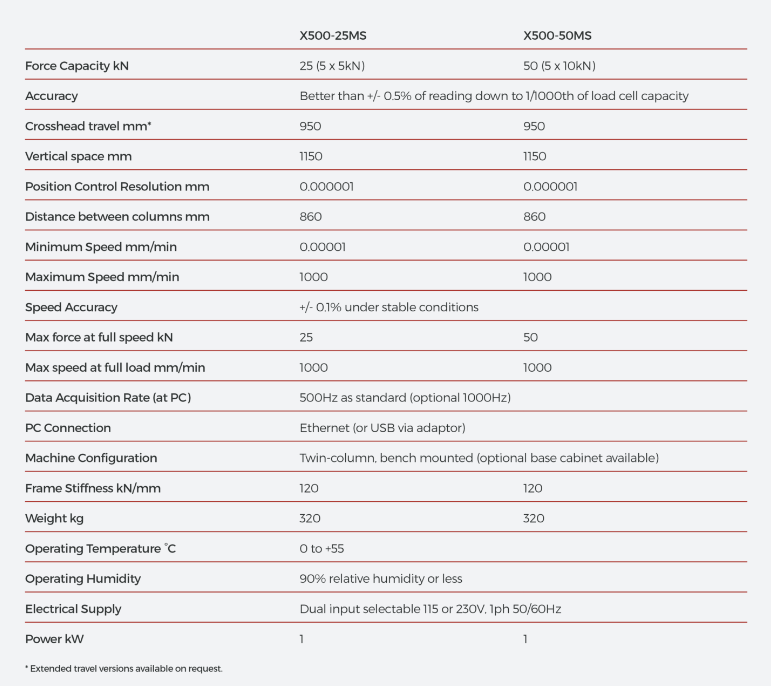
| Base platform | X500MS twin-column, bench-mounted universal testing machine | Capacity class | Configured for demanding applications up to 100 kN |
|---|---|---|---|
| Control | Fully digital PC control with precision AC servo drive | Software | WinTest-Analysis EC for method control, data capture and reporting |
| Load cells | High resolution, automatically recognised; selected by station and test force | Accuracy | Better than +/-0.5% down to 1/1000 of load cell capacity on Testometric platform specification |
| Motion system | Pre-loaded ballscrews, brushless servo drive and precise crosshead guidance | Data capture | High-speed data collection for synchronous channels and accessory inputs |
| Station layout | Station count, spacing and fixture layout defined by sample handling and cycle time | Fixtures | Grips, platens, peel fixtures, shear fixtures, puncture tools or custom jigs |
| Protection | Overload, overtravel, impact protection and load cell overload protection | Accessories | Extensometers, calipers, balances and other devices through expansion channels |
There is no generic multi-station standard. The test method drives the system.
Specify the station layout from the actual method, sample geometry, expected force and operator movement. Then validate each station against the same acceptance logic.
Tensile and peel stations
Use where several strips, films, tapes, textiles or small components need the same method, grip spacing and reporting format.
Compression and puncture stations
Useful for caps, closures, springs, foam, packaging parts, medical components and product checks with repeated fixtures.
Traceable force calibration
Force verification can be aligned with ISO 7500-1 or ASTM E4 where quality systems require each force channel to be traceable.
Fixture validation
Custom station tools should be proven for alignment, repeatability, operator loading, safe guarding and cleaning or changeover time.
Designed for routine decisions, not one-off screenshots.
Define these before FITCO quotes a multi-station system.
- Number of stations, specimen dimensions, loading sequence and expected samples per hour.
- Test type at each station, force range, travel requirement, grip or fixture geometry and guarding requirement.
- Whether stations run the same method, different methods, sequential loading or synchronized data capture.
- Report fields, pass/fail limits, barcode or batch tracking, calibration requirement and data export workflow.
Need a multi-station tester built around your workflow?
Send sample photos, station count, expected force range, target cycle time, fixture idea and report requirements.