
The OTR Advantage: Reliable Oxygen Transmission Testing for Rubber and Barrier Materials
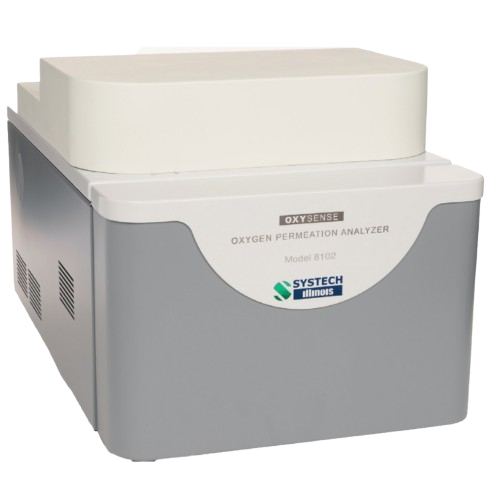
In rubber compounds, elastomers, barrier films, and multilayer structures, oxygen transmission data does more than fill a test report. It supports formulation decisions, quality release, and long-term performance confidence. The Systech Illinois OxySense 8101e is built for labs that need dependable OTR results across a wide range of material behaviors.


Why OTR testing matters
Reliable oxygen transmission data supports better product decisions
When oxygen transmission data is unreliable, downstream decisions become unreliable too. That is why broad range, repeatability, and independently verifiable performance matter just as much as sensitivity.
What engineers and QA teams need from OTR data
For rubber, elastomer, barrier film, and multilayer structures, the key question is rarely whether oxygen transmission can be measured. The real question is whether the measurement stays accurate, repeatable, and practical across very different permeability behaviors.
Coverage across diverse materials
Labs often need one platform that can handle both high-barrier samples and highly permeable materials without switching systems.
Multiple condition profiles
Temperature and humidity can change the behavior of rubber and barrier structures significantly, so a single-condition result is not always enough.
Protection against abnormal samples
Pinholes and unexpected high-transmission specimens can disrupt a testing schedule and create avoidable maintenance cost if the sensor is not protected.
Repeatable test end points
Operator guesswork around equilibrium increases variability and can waste gas, time, and sensor life.
Defensible validation
Labs increasingly need not just repeatable numbers, but results that can be independently verified when customers or audits demand proof.
Method and validation context
The OxySense 8101e advantage
Reliable OTR testing without narrowing your material range
The OxySense 8101e combines wide-range sensing, automated condition control, and practical protection against abnormal samples. The result is a testing workflow that stays useful across rubber, elastomers, barrier films, and related materials.
1. Wide measurement range for diverse materials
Its eMetric sensor technology covers 0.05 to 432,000 cc/(m2.day), allowing one instrument to span high-barrier structures and high-transmission samples.
- Supports variable permeability behavior on one platform
- Reduces dependence on multiple dedicated systems
- Improves continuity between R&D and QA work
2. Faster material profiling with TCM
The Test Condition Matrix feature enables testing at up to ten temperature and humidity conditions with a single setup.
- Build broader performance profiles with less operator intervention
- Reduce repeated setup time between condition changes
- See how materials behave across real operating environments
3. Better protection from sample surprises
Oxygen surge protection detects excessive oxygen levels and helps protect the sensor when pinholes or very high-transmission samples appear.
- Helps reduce unplanned downtime
- Protects against avoidable sensor damage
- Improves resilience in routine production testing
Additional workflow advantages
4. Auto-Stop at true equilibrium
Auto-Stop determines when the sample has truly reached equilibrium and ends the test automatically, improving repeatability while reducing operator guesswork.
5. Rapid wet-to-dry conversion
Moving from saturated wet testing to dry testing in minutes rather than hours increases daily throughput in busy QA and R&D labs.
6. Confidence through independent verification
Open-loop validation with 3rd-party certified gas standards provides independently verifiable, NIST-traceable confirmation of instrument performance.
Where this matters most
The strongest fit is in labs that need dependable oxygen transmission data across a mix of materials, structures, and condition profiles without sacrificing throughput.
Rubber air-retention applications
Useful where permeability affects retention performance, service life, and consistency from batch to batch.
Barrier films and multilayer laminates
Supports evaluation of structures where oxygen ingress directly affects product protection and shelf life expectations.
Coated and specialty materials
Helps teams understand how coatings, formulations, or process changes alter oxygen barrier behavior.
QA release and troubleshooting
Useful for release confidence, comparative screening, and investigation when abnormal samples or leaks appear.
What the data supports
Client logo wall from the product page
The same global brand visuals used on the OxySense 8101e page are included below so the article carries the full image set from that source page.
 Reliance
 Nestle
 ITC
ITC
 UFLEX
UFLEX
 KHS
KHS
 Amcor
Amcor
 Plastipak
 Cambridge
 Abbott
 Constantia
 B.Braun
In summary
The Systech Illinois OxySense 8101e brings sensitivity, wide-range capability, automation, and verifiable accuracy together in one system. For labs testing rubber, elastomers, barrier films, and related materials, that means more dependable OTR decisions, better repeatability, and less wasted time between conditions. It is a strong fit for teams that need performance aligned with ASTM D3985-style expectations while keeping lab productivity high.
Need dependable OTR testing for rubber or barrier materials?
FITCO India can help you review your application, compare test requirements, and configure the right Industrial Physics solution for your lab.